Author: Alejandro Malespin

The Elementary Classroom

Students learn best within an environment prepared to nurture and enhance each student’s unique development.

  • Multi-Age Groupings – Elementary Montessori classrooms are comprised of multi-age groupings. This is the practice of teaching students of different ages and abilities together without organizing either the curriculum or the classroom by age or grade designations. The students remain in the same classroom, with the same instructors, for several years.
  • Classroom Areas – The elementary Montessori classroom is divided into distinct curriculum areas: Science, Geography, History, Art, Math and Language. Many of these subjects are then organized into separate skill areas. There is a large floor area for spreading out work and gathering in for community meetings and lessons. There are tables for individual and group activities. The students have notebooks for recording their work and folders to store ongoing projects. Group supplies are located in a central area. A message board displays the day’s schedule as well as reminders and announcements. A wide variety of plants and animals are located throughout the classroom. Arrangements of cut flowers often decorate the tables and music is almost always playing in the background. Replicas of artists’ work adorn the walls. Cleaning materials are accessible to the students since they are custodians of their classroom. A library is located nearby and available for the students to visit in order to support their research and interests.
  • Materials – The wealth of materials in each area allows the students to follow their own interests. Materials are arranged so as to allow sequential progress in skills. Usually there is only one example of each material to encourage turn taking and patience. Materials and their activities vary from individual work to partner work to group activities. The materials are aesthetically pleasing with a great many being teacher-made. Many of the materials employ an internal control of error so as to encourage self-monitoring and foster independence in the elementary student.

The Elementary Student

The elementary Montessori program and curriculum is structured around the very specific needs and characteristics of students between the ages of six and twelve years.

  • Reason & Imagination – The inquisitive nature of the elementary student provides the fuel for the research and exploration focus of elementary Montessori. The elementary student wants to know the “why?” and “how?” The six- to twelve-year-old is able to use both reason and imagination to explore and understand increasingly abstract concepts.
  • Exploring Society – While the early childhood student was primarily focused on the construction of the individual, the elementary student begins to explore his place in society. Opportunities continuously present themselves for the student to observe or participate, moments in which to lead or follow.
  • A Need for Togetherness – This is the age of clubs and groups. The elementary student explores friendship and cooperation; he learns how to be a leader, a partner and a follower. While collaboration is encouraged, individual contribution and strength is also valued.
  • Exploring Right and Wrong – The six- to twelve-year-old student is actively developing his moral conscience; “That’s not fair!” is heard over and over again in the elementary classroom. Every student may know the rules but keeping them is another matter. Problem solving techniques are modeled and fostered in the Montessori program. Community brainstorming for solutions and rules helps form the elementary Montessori classroom’s code of conduct.
  • Freedom & Discipline – Independence and inner discipline continue to develop in the elementary years. The six- to twelve-year-old student is capable of increasingly complex and numerous responsibilities and needs opportunities to exercise judgment and demonstrate self-conduct. Everything from classroom management to the student’s work stems from the student’s freedom to choose and think. Mistakes and failures are viewed as learning opportunities.

Why Spanish?

The United States has approximately 50 million Spanish speakers.  The Western United States including Utah have the highest percentage of Spanish speakers.  Demographic and economic trends, including greater purchasing power among Latinos and Spanish speakers and interconnectedness in the Americas from Canada to Chile, suggest Spanish will grow even more important throughout the century. Additional reasons for learning languages including better access to other cultures and communication possibilities.

Why should my child be enrolled in dual language?

  • The dual language program offers your child the chance to develop communication ability in Spanish and English. This could be difficult at first, but being bilingual may enhance your child’s potential opportunities (jobs, culture, etc).
  • Acquisition of language by children has been studied widely. Children have advantages over adults in language learning. Natural curiosity and a willingness to make mistakes help the child. Adults often hesitate when speaking another language for fear of erroneous pronunciation or grammar. Children, especially young children, tend not to have that fear.
  • Children easily pick up and model accents. Few adults who learn other languages pick up the correct accents. Many children do to the point at which they pronounce as well as a native speaker. Of course, those children generally start to learn the language before their teens with the help of native speakers.

Does it affect or help my child if I have a language background?

Every child that is enrolled in the Dual Program goes through the same process of learning. Children who hear other languages spoken at home tend to learn languages faster.  Some ideas for home are:

  • Interact with your child.
  • Learn about dual language education.
  • Encourage your child to speak the second language.
  • Give your child the benefit of the doubt.
  • Do not ask your child to translate. This requires advanced skills that could frustrate your child.
  • Try to avoid comparing your child’s progress to that of other children. Rates of progress differ.
  • Be willing to participate in opportunities to expose your child to Spanish and culture(s)outside school.
  • Praise your child for his or her progress.


How does the Dual Language Program work at Montessori Community School?

In the dual language class, children are encouraged to evenly divide their time between Montessori works in English and Spanish. One teacher speaks and presents lessons to the children in English while the other speaks and presents lessons in Spanish. Teachers generally speak their native language though the Spanish teachers are bilingual in case a child needs assistance in English. With time, every child in the class will learn Spanish. Children in the classroom have the opportunity to learn how to communicate in both languages. They will experience speaking, listening, reading and writing. Reading and speaking in both languages is necessary to become bilingual, bi-literate and bicultural.

Montessori: Your Daily Dose of Resilience-Building

Raising children in the twenty-first century is a most rewarding challenge. In modern society we have increased access to mass media and greater sprawl within families. Youth are increasingly influenced by sources of information beyond parental control. Thus, our task as parents is to figure out how to balance sheltering our children while still preparing them for the future.

Research has identified many key elements that predict better quality of life in adulthood; academic achievement, absence of medical and mental health problems, financial stability, and rewarding social connections with others. Yet most of us at one point or another face situations that create vulnerabilities in these areas. So this begs the question, how do we bounce back? And more importantly, how do we teach our children to demonstrate the same perseverance when faced with stressors?

Everyday I work with families who are striving to bolster the skills and abilities of their children. They seek to help them to adapt to current stressors and challenges, and to acquire characteristics likely to help them lead a successful life in the future. My method of teaching is based on building resilience.

Drs. Goldstein and Brooks, authors of Raising Resilient Children (2002) stated, “Resilient children can cope effectively with stress, pressure, and everyday challenges. They appear capable of bouncing back from disappointments, adversity or trauma. They learn to develop and set realistic goals for themselves and those in their lives. They are capable of solving problems and interacting comfortably with others. They possess self-discipline and a sense of self-respect and dignity.” Temperamental differences can play a role in how resilient children are, but this mindset can also be taught in everyday interactions.

One of the most inspiring lessons I have learned through teaching others is that there are so many consistencies between the guideposts of Resilient Parenting and the tenets of the Montessori Method. Let’s examine a few:

First, resilience-minded parents teach their children to solve problems and make decisions. This allows children to have a sense that they can control what happens to them. This mentality fosters independence and a sense of responsibility. The Montessori classroom allows children to develop self-reliance by making choices and dealing with the consequences of their choices. Children develop awareness and trust in their decision-making through the feedback loops of choices and consequences.

Second, resilience-minded parents discipline in ways that promote self-discipline and self-worth. This helps children to appreciate mistakes as opportunities for learning rather than indications of failure, furthering the child’s emerging sense of ownership and responsibility. Positive feedback, encouragement, natural and logical consequences are all powerful teaching tools. The Montessori classroom also encourages children to learn from mistakes and successes by allowing for independent decision-making. Children make choices and experiment within a well-prepared environment that promotes creativity, confidence, and a sense of purpose. It is appreciated that children need time and practice to master new skills and that unnecessary help actually hinders development. Montessori truly embraces the “help me help myself” attitude.

Numerous other similarities can be drawn out between the Montessori Method and resilient parenting practices such that I consider Montessori a model of resilient education, with well-trained teachers to serve as additional charismatic, influential adults in our children’s lives during the school day. As parents, we are in a unique position to extend these teachings. Parents can adopt a mindset of resilient parenting “to foster strength, hope and optimism in our children” everyday.

Melissa DeVries, Ph.D., Licensed Psychologist

Please join us on March 4th from 6:30pm – 8:00pm as Melissa DeVries, Ph.D., an MCS parent and our school psychologist, shares more about raising resilient children and how a Montessori education supports resiliency.

2014 Performing Arts Showcase

The Willows and Sequoias Music and Dance Performing Arts Showcase “Commotion in the Ocean” on Tuesday night was a great show! The performance began with both classes singing a variety of songs and this was followed by four group dance numbers – two from each class.

As usual, we had our little extroverts who danced and sang with such enthusiasm and on the other end of the spectrum those who were more shy and reserved. It is all a learning experience and we were absolutely delighted to see them growing and celebrating together.

Many thanks to all the parents, grandparents, and family friends for coming out to support your children. They are all beautiful and talented. We are very grateful to be working with them!


Aspens and Magnolias Music and Dance Performing Arts Showcase “Commotion in the Ocean” on Tuesday was absolutely delightful!

*Please watch for an announcement of upcoming Arts Showcases to display Art Specialist Kindra Fehr’s work with our Kindergarten through Middle School students later in the Spring!*

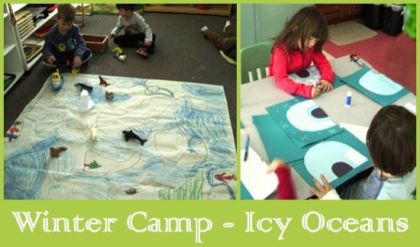
Winter Camp – Icy Oceans

The theme for Winter Camp this year was “Icy Oceans – the Antarctic and Arctic Oceans.” With Corey heading the camp and Kellie assisting her the children had the opportunity to be involved in many fun-filled activities.

There were science experiments where the children learned how snow turns to ice, why icebergs float, how glaciers move and how temperature and salinity affects the melting of the ice.

The children also learned more about the location of the Arctic and Antarctic Oceans and why they are so cold. They participated in exploratory activities about Giant Jelly Fish, Polar Bears, Narwhals, Emperor Penguins, Ring Seals, The Northern Lights & the conditions that create such amazing colors, plants and organisms that grow in ice and on the ocean floor, and so much more!

This was definitely a fun filled six days and all the children had a wonderful time. Our thanks to Corey, Kellie and all the teachers who participated.

The Kindergarten Year in Montessori

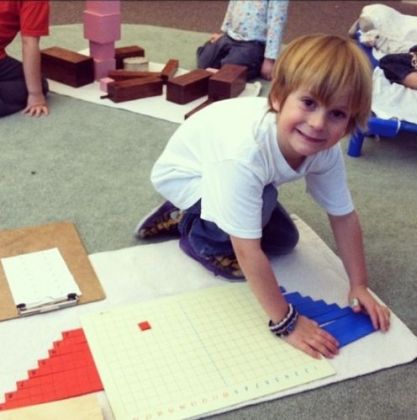
An MCS Kindergarten student works on the Addition Strip board discovering “Ways to Make 10”

Kindergarten is the harvest year for all the planting and intellectual tending that has gone on for the preceding years in preschool. The kindergarten child’s learning explodes into an avalanche of reading and writing and math. All of the earlier preparation (practical life, sensorial) now finds academic outlets. The kindergarten child not only gains a wider breadth of knowledge but a deeper understanding of what she has learned and now is able to use this knowledge to enhance her own intellectual pursuits.

A Montessori education is not just cumulative in its learning; it is exponential in its understanding. The learning that happens in kindergarten is not just adding another year’s knowledge but multiplying what is learned and applying it to what is to come.

It is common for Montessori kindergarten graduates to be able to read well (and write) and to understand math far beyond addition and subtraction all the way to multiplication, division and geometry.

To miss this formative year that sets successful life patterns is to miss the ultimate advantage of this unique preschool experience.Maybe even more significantly, the lifetime patterns of responsibility, goal setting, having a work ethic, working through mistakes, inquiry and curiosity are being firmly set.

The kindergarten year in a Montessori classroom is also the year of mentoring. It is the year when the five year old is able to really help her classmates. This mentoring year is significant for two reasons. First, when you teach others, you really master the subject for yourself. Second, when you are asked to teach you demonstrate your mastery of the material. It is this mastery that produces the profound feelings of self-confidence and assurance that is the hallmark of Montessori students. Real achievement and real achievement demonstrated builds real self-esteem.

Leaving the Montessori program before kindergarten often places a child into an educational setting that is not as advanced; nor one that allows for the initiative that has been carefully cultivated during the earlier preschool years. The child is often introduced to a different curriculum one that lacks the individual intellectual satisfaction that comes from exploring and discovering the wonderful world of learning found in Montessori.

The essence of successful life is to be able to make wise choices. The Montessori kindergarten student is at a major threshold of exercising that wise decision making power. To lose that opportunity is to lose a significant part of the hard won success of the preceding years.

The great gift of an education is not the accumulation of facts and statistics but the lighting of the fire of learning, discovery and joy. It is a gift that Montessori children have the privilege and pleasure of opening and using for a lifetime.