“Quote of the Week”
Happy Monday, everyone!

Happy Monday, everyone!
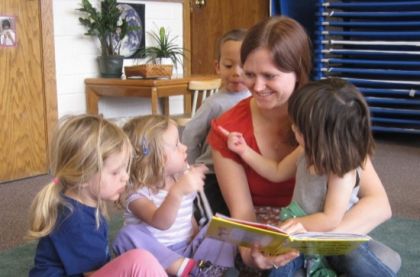
As parents we have to judge what makes a good educational program for our children. We ask our friends, we look at the school – is it clean and orderly and bright? We look at the children – do they seem happy? We observe the teacher – is she engaged and interested in the children? These are things that we can judge. And then we remember that we’ve heard that a low student–teacher ratio is important for a good educational approach and outcome. (It must be true because all of the governmental agencies are always trying to lower the ratios.)

But it is a myth as far as Montessori education is concerned. Traditionally, a low student–teacher ratio is desired if you are trying to make everyone do the same thing at the same time. (It is a lot like herding cats – the less you have, the easier it might be to perform.) Ratios aren’t critical in Montessori for three reasons.
Parents wonder still – “If there were fewer students wouldn’t my child get more attention from the teacher?” Interestingly, it is not just the amount of time your child needs but the amount of focused time (time spent directly on your child’s priorities and needs) that effectively contributes to her learning.
A Montessori teacher can be compared to a juggler who spins plates on a stick. She will begin spinning the first plate, then the second, third and fourth. She might go back and give the first plate a spin before she spins the fifth and sixth. She might then spin the second plate – and that first plate might need another spin before she gets the seventh plate rotating. Likewise, the teacher notes each of her students and what it takes to power up the learning gyroscope in each child – so the child can keep the learning plates spinning on her own. A low ratio is good if you are driving the learning – not as consequential if you are leading it.
Now, because the teacher doesn’t spend all of her time driving the learning, she has time to study each child(read more about observation here): to study her needs, her skills, her aptitudes and personality. All the ratios in the world are meaningless – unless you know your student.
Ironically, there are many advantages of not having a low student–teacher ratio in the classroom.
Montessori teachers have to train themselves in the art of not interfering with the internal learning process of the student. They have to train themselves to observe the child, to know how the child learns and how to allow the child to learn.
Ultimately, they have to learn how to help the child learn for herself – which is always one on one.
Article by Edward Fidellow

Montessori Cultural curriculum includes learning about Geography, Science, Music, Art, and Yoga. Throughout these studies, our students have become familiar with continents, oceans, and countries including but not limited to specific flora, fauna, flags, and folks. Montessori cultural education helps students to adapt to their own culture, inspires a love of learning, and offers a new perspective of the world. Within this spectrum, our students get the opportunity to do an in depth study of a particular culture, focusing on specific countries of our world and their uniqueness.
Thursday, April 24th our Elementary and Middle School students will be presenting their cultural studies for MCS’s Annual Cultural Fair from 6:00 pm – 7:30 pm in the MCS gymnasium. Our students’ presentations will remain set up throughout Friday, April 25th until late morning for all those wanting to swing by, view, support, and share in the success and hard work of our students.
Thanks again to Ute Crossfit owners and MCS parents Bobbi Jo and Tommy for providing a fantastic field trip for our Aspens class. The students (and parent chaperones and teachers) had a really great time!


MCS would like to wish our community a Happy Earth Day. What a lovely opportunity to celebrate the beauty of our miraculous earth. Montessori is known as a method that advocates environmental education and invites children to become stewards of the earth. Maria Montessori herself said that “children are inspired with a feeling for nature” and believed that nature plays a most important role in the development of the whole child.
Unconstructed play and exploration in nature foster creativity and independence. Students learn the value in community and their interconnectedness as they begin to recognize and care for living things. Richard Louv, author of ‘Lost Child in the Woods’ and proponent of the need for nature in education noted, “multisensory experiences in nature help to build the cognitive constructs necessary for sustained intellectual development.“ At present, electronics have an overwhelming presence in society and in the development of the child. Research indicates that this presence has the ability to hinder children’s overall development. So what do they need to counter all this visual stimulation? Outdoor experience! Time and effort in nature gives children the opportunity to experiment with cause and effect and avoidance of immediate gratification, which they experience so frequently with electronics.
One of the most unique principles of Montessori programs is the Cosmic Curriculum, an overall Montessori approach to education that involves helping children develop an awareness that everything in the universe is connected and interdependent and forms a harmonious whole and that they themselves are part of and contribute to that whole. The Cosmic Curriculum lends itself to exploration and appreciation of nature. Environmental education is a curriculum that encourages children to explore the wonders of nature; including botany, zoology, preservation of the earth, and other scientific concepts that are present in Montessori such as the study of the earth, water, weather and the universe as a whole. These subjects come alive with hands-on experience.
And so, in honor of this world wide celebration, we offer thanks to Maria Montessori and all those who join us in bettering our children’s future as we share insights to miracles of the universe through education of the child.
“When the child goes out, it is the world itself that offers itself to him. Let us take the child out to show him real things instead of making objects which represent ideas and closing them in cupboards.” Maria Montessori
Read more about our environmental education here.
GABRIEL GARCIA MARQUEZ, Nobel Prize-winning Novelist & Montessori Graduate Dies
Gabriel Garcia Marquez, the columbian author who won a Nobel Prize for literature was sent to a Montessori school and is an avid supporter of the philosophy. He stated, ” I do not believe there is a method better than Montessori for making children sensitive to the beauties of the world and awakening their curiosity regarding the secrets of life.”
His book, ‘One Hundred Years of Solitude’ has been named as the book that has most shaped world literature of the last 25 years.

“Montessori was like playing at being alive.”- Marquez
Farewell Letter – Credited to Marquez
If God, for a second, forgot what I have become and granted me a little bit more of life, I would use it to the best of my ability.
I wouldn’t, possibly, say everything that is in my mind, but I would be more thoughtful of all I say.
I would give merit to things not for what they are worth, but for what they mean to express.
I would sleep little, I would dream more, because I know that for every minute that we close our eyes, we waste 60 seconds of light.
I would walk while others stop; I would awake while others sleep.
If God would give me a little bit more of life, I would dress in a simple manner, I would place myself in front of the sun, leaving not only my body, but my soul naked at its mercy.
To all men, I would say how mistaken they are when they think that they stop falling in love when they grow old, without knowing that they grow old when they stop falling in love.
I would give wings to children, but I would leave it to them to learn how to fly by themselves.
To old people I would say that death doesn’t arrive when they grow old, but with forgetfulness.
I have learned so much with you all, I have learned that everybody wants to live on top of the mountain, without knowing that true happiness is obtained in the journey taken & the form used to reach the top of the hill.
I have learned that when a newborn baby holds, with its little hand, his father’s finger, it has trapped him for the rest of his life.
I have learned that a man has the right and obligation to look down at another man, only when that man needs help to get up from the ground.
Say always what you feel, not what you think.
If I knew that today is the last time that that I am going to see you asleep, I would hug you with all my strength and I would pray to the Lord to let me be the guardian angel of your soul.
If I knew that these are the last moments to see you, I would say “I love you.”
There is always tomorrow, and life gives us another opportunity to do things right, but in case I am wrong, and today is all that is left to me, I would love to tell you how much I love you & that I will never forget you.
Tomorrow is never guaranteed to anyone, young or old. Today could be the last time to see your loved ones, which is why you mustn’t wait; do it today, in case tomorrow never arrives.
I am sure you will be sorry you wasted the opportunity today to give a smile, a hug, a kiss, and that you were too busy to grant them their last wish.
Keep your loved ones near you; tell them in their ears and to their faces how much you need them and love them.
Love them and treat them well; take your time to tell them “I am sorry,” “forgive me, “please,” “thank you,” and all those loving words you know. Nobody will know you for your secret thought. Ask the Lord for wisdom and strength to express them.
Show your friends and loved ones how important they are to you.
Send this letter to those you love. If you don’t do it today…tomorrow will be like yesterday, and if you never do it, it doesn’t matter either, the moment to do it is now.
For you, with much love, Your Friend, Gabriel Garcia Marquez
At 10:15am today our school participated in an earthquake drill. The students practiced “drop and cover.” Once given the all clear the students and teachers evacuated the building. The drill was successful and following the drill our staff reviewed additional procedures that would benefit MCS in the event of an earthquake. Development of our Emergency Preparedness plan is ongoing. Some information can be found in our Parent Handbooks and we anticipate that by fall we will have a more detailed write-up to share with families.
Thank you for your ongoing support!


Audio played over our P.A. system to symbolize the earthquake.https://youtu.be/6VOtCH5jl5k
Thursday, April 17, 2014, Montessori Community School will participate in the Great Utah Shake Out. Our staff Emergency Preparedness team has met to review procedures and future preparation plans. Thursday at 10:15 am our students and staff will participate in an earth quake drill where we will practice “Drop, Cover and Hold On.” Then we will practice an evacuation of the building. Parents will be informed once all students have been accounted for. Many thanks to Ramira, Jan, Bob and the rest of our staff for your commitment to the safety of our staff and students.

What has allowed Montessori to stand the test of time? What has protected the method that first began in 1907? Many methods of education have been tried and tested for years in the United States but Montessori is one program that has not only stayed around, but is growing and receiving more recognition than ever. Montessori schools, including those in the public sector, are on the rise in the United States of America.
Most Montessorians will agree that beneath many layers the most basic element continues to exist. This simple concept that gives heed to the needs of the child is that of observation.
“The Montessori Method continues to serve children well because it is based on the scientific observation of individual children….The lessons, the materials, that careful order of presentation, work because, and only because, they respond to the observed needs of the individual child. Montessori requires consistent and objective research into the conditions of each child. Montessorians often seek peace first and precision later. But it is through the specificity of unbiased observation that our compassion emerges for each child we serve. It is by understanding the needs of each child, as a unique and concrete individual, that we see his humanity.”
Catherine McTamaney, The Tao of Montessori.
Montessori teachers are carefully trained in the skill of observation. Preparation of the environment, lesson plans, and daily scheduling are all reliant on their precise understanding of the needs of the children, which comes through observation. Through observation they gain the full picture and see any outlying factors that might affect a students learning patterns or behavior. Once a new concept is presented and practiced by a child, the adult is responsible to watch the child and ask “does the child do what they have been taught to do?” Again, this can apply to their practice of the materials and concepts in the classroom but is also applicable to behavior, social interactions, etc. Montessori teachers are also taught to think twice before interfering with anything a child is doing. Is the action purposeful and intentional? Is anyone or anything being harmed? Is their opportunity for growth?
In addition to the careful observation of the Montessori teacher, we encourage observation by the child in a Montessori environment. Through observation, children learn more than one way of doing things. They also learn the important and essential skill of patience. Children are encouraged to stop and think. As they learn to observe, they give themselves time to evaluate and think of outcomes. Observation is a beautiful skill for our young people as it allows them the ability to see the perspectives of others and the recognition that there can be more than one way. It supports the idea that we teach children to learn to think and love to learn.

