Open House for 2014-2015
Our Annual Admissions Open House is coming up. If you are interested in learning more about any of our programs we invite you to join us. Call the school for more information.
Our Annual Admissions Open House is coming up. If you are interested in learning more about any of our programs we invite you to join us. Call the school for more information.
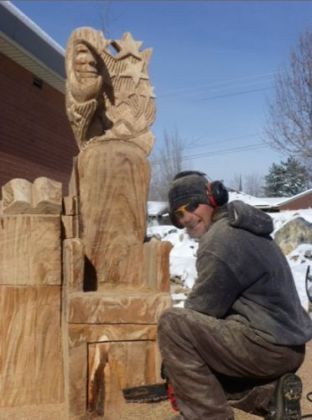
As we mentioned in a previous email a few weeks ago, we had to have most of an old elm tree which was located in the Outdoor Classroom cut down as it was shading part of our photovoltaic panels. This was a great loss for some of the teachers and students.
One family decided to spearhead a fundraiser in order to hire a wood carver to change the stump into something beautiful that all the school could enjoy. They asked me what I thought of the idea and although I loved it I felt that it was not the time of year to ask families if they would like to give money to the school for this project. I suggested that we wait until the Spring and then consider it. As it turned out this family who has asked to remain anonymous was so fired up that they decided to fund the project themselves as a gift to the school.
So for the past two weeks Jim Valentine, wood carver extraordinaire, has been working on our elm and the carving is near to completion. I would invite you to check out his work on Facebook and of course to visit our beautiful carved tree.
We feel so blessed to have been given such an incredible gift and know that it is going to be such a special place for our children to gather and enjoy for many years to come. We are truly grateful to our family who made this wonderful gift possible.

Dear Montessori Community School,
As you all know we have been collecting items for Syria such as coats, warm clothes, diapers, baby formula, and shoes. Thanks to all your help and generosity we were able to ship a 40 foot container and have enough items to fill a second 40 foot container and ship it.
These items will be going to Syrian people who have been forced to flee their homes due to the ongoing war and live in refugee camps near the border of Turkey. These people have lost their homes, members of their families, income, basic requirements to support their families and most of all, their sense of security. They are living in tents, some with nothing between them and the ground but a piece of carton. They have no electricity, some have no access to clean water or even food.
My Syrian friend who is working with many Syrian humanitarian organizations found that NuDay Syria can pay, through donations, for shipping containers overseas if we can fill them. So she decided to help prepare those helpless people for winter which is quickly approaching. Her project was called Keep Syria Warm.
Thanks to all the help from the community we were able to collect thousands of coats and sweaters, winter boots, medical supplies for the injured , baby formula and basic needs.On behalf of all the Syrian refugees anxiously awaiting these supplies, and myself, thank you to all of you for helping us send that container. It wouldn’t be feasible without your kindness. Also a special thanks to Robyn and Ramira who supported the project.
The Toddler Parent Education night on Positive Discipline was a great success. Thanks to Ms Meghan for co-ordinating the information and setting up the program and also to Ms Nanette, Ms Sophie and Ms Kenzee for their informative and often entertaining presentation. At various points during the evening parents asked follow up questions. The teachers always had great suggestions but reminded the parents that sometimes certain approaches will work and other times not and it is important to keep trying new tactics. It was stressed that it is vital to always be respectful of each child and to try not to get into a power struggle as this always ends up with one winner and one loser. It was also suggested that if a child was pushing them to their limits that they try to have the child take a break to calm themselves and if possible take a break themselves.
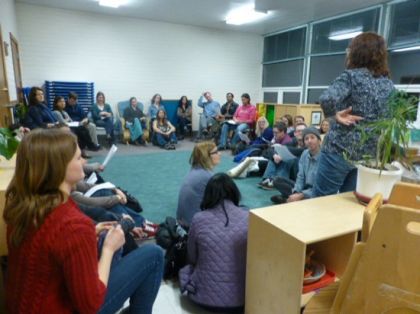
It is always heartening to hear other parents speaking of their struggles and frustrations so that it is clear that most people are experiencing the same issues and that this is normal stage of development for each child and that there are many ways to help make the process more manageable and hopefully enjoyable. There is no doubt that Toddlers are sometimes challenging but they are also so delightful, capable, inquisitive, lovable and growing and learning at such a rapid pace. We are most fortunate to have these children in our school community and our Toddler teachers are amazing. We are constantly impressed with their knowledge, patience and loving attitudes.
Dear Montessori Community School Families,
Please find below a list of the Giving Projects that our classes have chosen to support this Holiday Season. We sincerely thank all of you who have already donated. If you have not had the opportunity and would still like to help any of these adults or children who have great need of support please feel free to donate to any of the projects. You may well be drawn to one more than another and we want you to know that anything you can give to any of these projects will be so gratefully received and will make a real difference in the recipients lives.

by Edward Fidellow
It is amazing to observe the breadth of accomplishment that a Montessori environment fosters. Courage is not traditionally thought of as an educational outcome but then again Montessori is not traditional. For children, courage is the ability to try new things even if I am afraid. And as they mature courage becomes the ability to do what is right and to do what is good.
For a child everything is new. That is the reality of childhood. The awesome task and purpose of childhood is to create the adult. Life takes courage to navigate and to become a fully functioning independent adult. And it is this kind of courage that must be nurtured and practiced for it to become a practical virtue.
We tend to identify courage with physical courage – running into a burning building, pulling people out of rivers etc. However, real life every day common courage demonstrates itself in intellectual, emotional and spiritual settings. The courage to do what is right, to do what is good for others, to use our gifts, talents and opportunities well and wisely is the kind of courage practiced and displayed in a Montessori environment.
We well understand that the opposite of courage is fear. But for a child fear doesn’t yet have a definition. It is represented by an indistinct but palpable feeling of unease. For a child fear is “defined” by the unknown, the unfamiliar. (That is why Montessori children love and are so at home in their environments because of its constant sameness and familiarity.)
For the child conscious fear starts from the unknown – the dog, the dark, strangers and then becomes attached to the inability (and frustration) of not being able to handle and control the environment – bringing it back to sameness. (Perfectionist children come to this earlier than others.) Then this fear attaches itself to the perceived rejection that comes from disapproval. The child, unconsciously thinks, that if I only do what is absolutely safe or what receives guaranteed adult approval I don’t have any reason to fear or face disapproval.
One of the hardest concepts for a new Montessori teacher to understand (and embrace) is that of not correcting children in the middle of their work. (This is particularly difficult for perfectionists and controllers.) Unless the child is damaging the material or endangering others or himself or being rude you let them continue. There are two outcomes to not correcting the child in the midst of the work. One, the child discovers his own mistake and corrects it which produces a sense of accomplishment and control. The second outcome is far more subtle. Because you are not corrected at every turn, you do not freeze up; you do not constantly look over your shoulder; you are not waiting for the next shoe to drop. You gain breathing room to make mistakes – that’s how we learn. In this way mistakes do not become the end of the universe or the world as we know it. The child is willing to try something new (which is an act of courage) without being weighed down with the fear of failure or reproof.
scaled
Not being corrected (all of the time) is the strange and unique Montessori training ground for courage. In trying something new the child gets to practice courage every day. Eventually, the child becomes use to trying new things without the overpowering fear of failure. The child learns to work his way through mistakes which becomes a normal part of life and the learning process – which is a significant part of adult life.
Life requires courage to live fully. The Montessori classroom provides daily opportunities to develop and practice courage.
Becoming a Montessori Parent
by Edward Fidellow
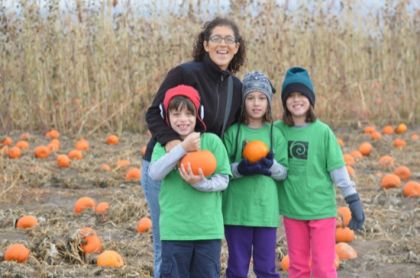
This Montessori parent, and school administrator, joins her three Montessori children on a field trip this fall.
There are seven simple steps to becoming a Montessori parent. When we say simple we don’t mean that they are not challenging. It is a lot like the definition of bull riding. “The object is to keep the bull between you and the ground.” Simple – but challenging.
The first step to becoming a Montessori parent took place when you enrolled your child in a Montessori program. That in itself is a challenge. Most of us weren’t raised in a Montessori school. The whole concept is foreign and takes a bit of courage to step out of the norm and our comfort zone. We may have chosen the program because it wasn’t like our school experience (which is why we chose it.) Or we chose it because we saw something unique in a Montessori child we knew. Or we were just plain lucky and stumbled on to a Montessori school and were fascinated by what we saw. Even then we had to deal with the question, “If this is so great, how come the whole world isn’t lined up outside the door to enroll?” (Which is the same question Montessorians keep wondering about too!) But you made a complex and challenging decision to become a Montessori parent. And here you are. So how do you get the best out of your decision? You go to step two.
You begin to understand the core philosophy of what Montessori is all about. Fortunately, you don’t have to become a Montessori teacher to be a good Montessori parent. (You don’t have to know how to manipulate all of those materials and you don’t have to keep fifteen children from climbing the walls.) The most significant Montessori concept is to respect the child. I can almost hear the wheels turning “Of course I respect my child, I love them very much that’s why I have them in Montessori, I want the best for them.” Of course you love them – but respect is different. Respecting the child is first, to respect the nature of children. Children are not mini adults waiting to be molded. They are like tadpoles and caterpillars that have their own form and function of life waiting to become what they are intended to be. We are often impatient for them to become because we don’t realize that childhood – with its curiosity, playfulness, messiness and all – is part of the process of them transforming themselves into the adults they will become. We have to respect that process – which doesn’t mean they always get to do what they want. One of the operative words in Dr. Montessori’s writing is the word “train”. We do need to train our children but we need to train ourselves “not to destroy that which is good” in the nature of our children. The second part of respect is to respect the personality of your child. Your child is not a blank slate. They are already imbued with the unique characteristics of who they are. The artistic bent is already there. The math bent is already formed. The leader, the follower, the giver, the taker, the extrovert, the introvert are already dna’d into your child. Right or left handed, right or left brained are already formed.
So how do you cooperate with nature? You become an observer. That is the next step in becoming a Montessori parent – you train yourself to observe. What does your child gravitate to? What gives them great joy? What occupies them endlessly? These are all clues to who your child is becoming. You are fortunate that you have a trained helper in your child’s Montessori teacher. Your next parent conference should ask more than what has she done but who do you see her becoming. It is hard to cooperate with nature if you are not aware of the nature of your child.
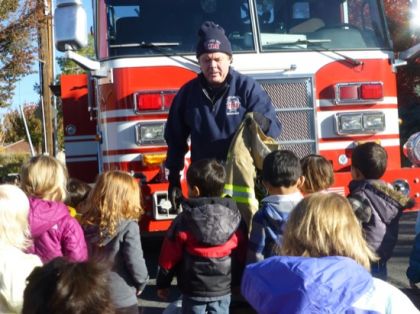
Our third step is to become their champion. I know. I hear you say, “Of course, I’m their champion. I love them.” And so you do. But are their goals your goals? Translation: Do you have goals for them that do not take into account who they are. (There are many jock fathers who do not have jock sons.) Yes, you have many wonderful goals for them to be caring and loving, honest and faithful, upright, truthful, etc – and these are worthy, significant and meaningful goals which they should attain to. But the expression of their lives – career, vocation, work – is best met and fulfilled according to their gifts. When your five year old says, “I want to be a fireman.” He may be reflecting the latest book or television program he’s seen. However, if you continue to ask the why questions, “Why do you think that would be a good job? Why do you think that you would enjoy that?” you may discover that your child is not drawn just to the excitement but to the fact of wanting to help people or he likes the aspect of being part of a team. All are important clues to his personality. Your child needs you to champion and encourage his personality (especially, if it is different than yours.)
The fourth step is to practice what they learn at school – grace and courtesy. Please and thank you, may I, excuse me, please forgive me and a host of other considerations practiced (and modeled) at home will go a long way to giving your child every advantage in life. People respond favorably to a child with great manners.
Fifth, practice independence. Independence is the ability to be self-governing and that comes from making choices, living with the consequences and having responsibilities. As often as possible give your children choices. “What do you want for breakfast, cereal or eggs?” “Do you want two spoonfuls of carrots or one?” (Don’t offer choices where there are no choices. “Do you want carrots? They say no and you serve them anyway.) Give your children chores they can accomplish – making their beds, putting dirty clothes in the laundry, dishes in the dishwasher, etc. Chores build responsibility; responsibility builds independence; independence builds confidence.
Sixth, give them the gift of time. Give them time to accomplish their chores. Give them time to be children. Give them time to breath. Give them your time.
Seventh, practice humility. They have a lot to learn from you. What is easy for you as an adult is mystifying and beyond challenge for them. Let your words be seasoned with grace. Look for the good in what they do. Their motives are often pure; their actions imperfect. Yet, we have a lot to learn from them also. And when you are wrong (when, not if) practice the humility of saying, “Please forgive me.” It will not destroy your authority or their respect for you. It will teach them one of the great lessons of life – when you fail, whether it’s in a relationship, school, career or life – own the failure and start over again – to succeed another day.
Becoming a Montessori parent is to become the best parent you can be.
A warm appreciation to all who planned and attended our Silent Journey and Discovery this November. As always, it was a delight to share this experience with many of you. As in past years, those who are able to experience the Silent Journey and Discovery have a renewed commitment to a Montessori education for their children. Below we have shared some comments from some of this years attendees.
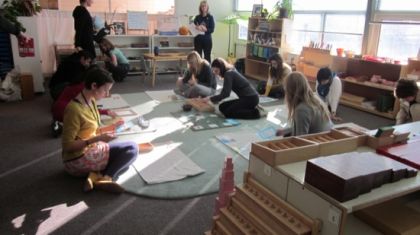
Parent practice using materials in an Early Childhood classroom.
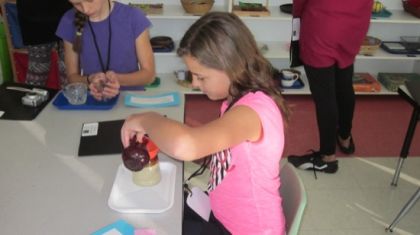
This 6th Year student volunteer models use of a pouring exercise in an Early Childhood classroom.
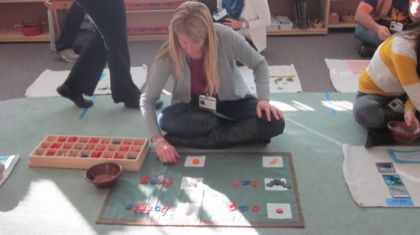
This parent builds words with the Movable Alphabet.
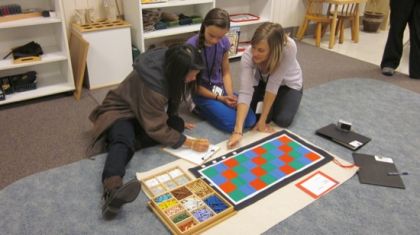
These SJ&D attendees receive a lesson on Checkerboard Multiplication.
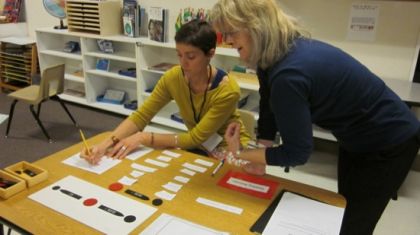
This parent practices sentence analysis.
“Our little girl started this October in one of the Toddler classes. We felt and understood how this would be a good environment for our daughter–we saw a difference in her after only a week! The only thing to say after experiencing Silent Journey is we THOUGHT we understood how good of an environment this is for our daughter. The progression through the classrooms and the works is absolutely brilliant. There is no way we would want anything different for our precious little girl. The system set in place is orderly, focusing on progression, growth, and learning pertaining to independence, reading, math, social skills, morals, ethics, and problem solving. We noticed how ‘hands on’ and multi faceted every work is designed to engage the children on their level with their own learning abilities and processes.
We were also so impressed with the educators- the individual time, care, and attention they put into their students. They truly know and understand each individual child they work with.
We discovered how the works build. The one that stuck out to us the most was the math. Starting early with dimensions, and stacking blocks moving toward cubes and counting- and onto multiplying enormous numbers by using a mat and beads- Absolutely incredible.
Math was a subject I struggled with and I can remember the exact time (2nd grade) when I got left behind. We had to pass off times tables with the teacher in front of the whole class. I was too shy and embarrassed to perform those simple times tables in front of the class for fear of getting them wrong or not being able to have them memorized the way all the other kids seemed to be able to do. I struggled the rest of my life with the ominous subject. During Silent Journey, when I reached Lower Elementary, I got it. I actually got a little emotional watching and doing the hands on mathematics. Both my husband and I just kept saying that we wished we would have had this type of learning environment available to us as kids.
We know the school is expensive; however, we walked away from Silent Journey thinking it is worth every penny and we would pay it twice over to have our children here. In our minds, there is no other way that can hone in on every aspect of learning for each individual child and still be able to provide loving, passionate, engaging teachers to foster a child’s learning and progression. Thank you so much for this amazing opportunity and for this incredible school. You really do ‘get it’ here. ”
Chad and Ashlee Haslam, Parents of a Toddler student
“I think it should be mandatory that every parent go through silent journey! Even though Aria has been here for 7 years, Azur 3 years, and I have taught art on and off during all of that time, I never really got it as I did Saturday. Suddenly, all that I had read about Montessori or observed in the classrooms made sense. It builds on itself in a beautiful way as the student moves from one phase to another. I loved seeing how things made sense in a concrete way and then transitioned towards abstraction. I’m so honored to provide my children with this opportunity.”
Kindra Fehr, Parent of Early Childhood and Upper Elementary students
Join us to experience our classrooms, from Toddlers through Middle School, to see for yourself how the lessons learned in our early programs set the tone and lay important foundations for later learning. This is a wonderful opportunity to gain a sense of how the Cosmic Montessori Curriculum unfolds for the child.
Read about some parents experience of the Silent Journey and Discovery from previous years:
Having not grown up in a Montessori environment, it has been difficult for me to understand what exactly a day in the life of my Montessori students is like. I try to take in as much as I can at pick-up and drop-off, with the occasional visit and guided lesson by my children, but there is no way to fully understand without an experience like the Silent Journey and Discovery. It was an eye-opening voyage that I would recommend for every parent, and prospective parent. I want to do it again.
Going through a classroom from each cycle really makes the whole Montessori experience come full circle from seeing how the Toddlers get their first understanding of space and shape, to Early Childhood and their practical life lessons, to Lower Elementary and their grammar materials which encourage socialization, to the Upper Elementary complex math problems, to a Middle School student-led Socratic discussion. We only saw the tip of the iceberg, but the hands-on learning experience helped personify the school life of our children. I was struck by the thoughtful organization of each room; how comfortable and serene a small space can feel.
I also enjoyed the roundtable discussion following our classroom journeys. We were able to get some insight from teachers, staff, students and other parents. Because Montessori isn’t the “traditional” schooling for kids in our country, there are obvious concerns and hesitations with going outside the “norm”. Many of my concerns were put to ease and I feel my children are on the correct path for them at this time. I appreciated the book recommendations and feel they will help in understanding the Montessori Method and perhaps assist me with decisions for my family down the road.
My kids have been at MCS for three/four years now and I feel like I have finally been able to look beyond the curtain of their daily journey, something that every parent should see and experience. Now, when my kids and I have our chats at the end of the day, I can ask even more detailed questions and have a bit more understanding as to how their day went. That is priceless.
Thanks again to all who helped facilitate the Silent Journey and Discovery.
-Carrie Christensen, mother to Lucas and Emily
The Silent Journey and Discovery was a very emotional and powerful experience for me. I did not attend a Montessori school as a child so I am only familiar with the Montessori philosophy through what I have read and observed in the last two years. It gave me a great appreciation and understanding of the different developmental levels of the works. I loved seeing the progression and advancement of the works through Toddler, Early Childhood and up through Middle School. The grammar and math works were thrilling to learn and experience. The focus on the sensorial aspects of each work creates a love of learning. In addition to receiving an amazing education the students are also learning how to be independent, respectful and loving human beings. I think every MCS parent should participate in the Silent Journey and Discovery to really understand and appreciate the experience and education we are giving our children. I know that it made me realize that I will do everything in my power to continue my daughter’s Montessori education.
-Tonia Hashimoto, mother to Savvy Williams
The Outdoor Classroom is a program that has been with the school for over seven years, and was conceived and developed by Ms. Donda Hartfield. This program is unique to our school, and gives our students a way to connect to their natural environment in a meaningful and expressive way. Spanning around the North- East corner of the school, our Outdoor Classroom is a beautiful natural trail, with gorgeous wildflowers, Utah-native plants, trees and geological treasures. The school also hosts a natural amphitheater, where Ms. Donda gives lessons and instructions before the children are free to explore on their own.
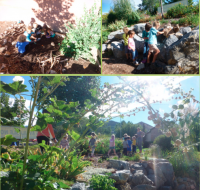
Through activities, lessons and especially time set aside to spend within the natural environment, our children learn about their world and it’s beauty. They come to understand the fragility of a plant, the necessity of a flower, the purpose of a bee. Miss Donda has enjoyed many years of her students’ discoveries, and she shares with us her teaching experience:
“When a student makes references such as, ‘The leaves of the California poppy look like reindeer antlers’ or, ‘I found a see-through plant’ I can celebrate that these students are taking time to observe their natural environment closely and therefore, they are learning about natural nuances and details that make our world uniquely beautiful and effective.” She continues by saying: “When a student shows deep concern for a tree that has string tied to its branches for bird-feeder ornaments because ‘It might be pulling down on the branches,’ I know I can trust that she is learning to care for her environment.” “It is through these kinds of observations that I can smile and know that these students are appreciating and relating with their surroundings in a memorable way.”
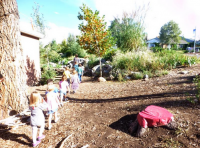
It was a great pleasure to attend the first Early Childhood lesson on “Land.” Miss Donda said to the children: “Look under your feet- you will see the land.” “I am standing on the land, you are standing on the land.” Her lesson reflected the great importance of the land. The children were able to dig holes in the soil together, but were asked to then fill the hole back up. There lies a genuine metaphor here: if you use the land, you must return it. The children might not know at such a young age what they are cultivating by their participation, but they are becoming considerate and thoughtful citizens of our remarkable planet Earth. Just as the Montessori Classroom places great trust in the hands-on learning process, so does the Outdoor Classroom program at MCS. The children learn through what they are able to see, touch and smell, and through the rare feeling of human freedom that one gets from living presently in nature.
Miss Donda tells us: “There is so much to be gained from simply engaging in our natural environment. And by engaging, I don’t mean necessarily hiking up to the summit of a mountain. Engaging is truly listening and looking at the landscape, the rivers, the trees and plants, the sounds of the birds and the passing of the clouds. Engaging is attending to our own naturalness through the breeze and the movement of the leaves, as well as the rise and fall of your own breathing and the subtle, yet profound connection between the two.