Author: Alejandro Malespin

Important Deadlines and Schedule Change Information

Dear MCS Families,

In recent years we have seen increasing numbers of families choosing to register their children for our full year option.  In reviewing the number of children already enrolled for our Summer Camp 2016, we are nearing capacity in all of our program levels.  Because of this, we are electing at this time to discontinue offering separate sessions of Summer Camp, and we will not be distributing separate flyers or rates strictly for Summer Camp.

With available spaces being so limited, anyone wishing to add Summer Camp to their schedule will need to do so by changing their schedule option from school year to full year.  These requests will be accepted on a first come-first served basis dependent upon availability and will reserve space for your child for the entire 9 weeks of Summer Camp running from June 13, 2016 through August 12, 2016.  When all spaces have been filled, we will begin a waiting list.

Parents who have previously elected the full year option but now wish to withdraw their child from Summer Camp have until January 31, 2016 to do so in order to avoid responsibility for the summer tuition.  Withdrawals made after January 31st will result in the parents being responsible for summer tuition in accordance with our withdrawal policies.  Should parents choose to remove Summer Camp from their child’s schedule, we will then offer those spaces to families who have been placed on the waiting list.

If you would like to make any schedule changes please email me at AshleeHaslam@mcsslc.com.


Best,

Ashlee

Teaching Gratitude to Children

One time when one of my boys was about four years old I found myself in a common battle trying to get him to clean take care of his belongings and clean up the toys that were scattered about his play room. I felt good about our system and knew that I was not asking him to complete a task that was outside his ability to complete.  We had cleaned the room successfully on a number of occasions. Finally, out of frustration, I told my son that if he did not clean up the toys I was going to gather them up, put them in a garbage bag, and give them to children who didn’t have any toys.  I left the room and, to bolster my threat, returned seconds later with a large trash bag.  My son approached me with an armful of toys and dropped them passionately in to the open bag.  Baffled, I asked “what are you doing?”  and tearfully he replied “I didn’t know there were kids without any toys.”

My heart ached.  Not that he had discovered something so disturbing to him, not that I hadn’t really intended to make good on my promise, and not even that there actually are children without toys…in that moment my heart ached because I had failed to help instill in him a sense of interconnectedness among our society.  I had a hard moment of realization that this little person was so willing to give of himself and of his most prized possessions and I had not yet given him the opportunity.  Our young children, at their most vulnerable and impressionable development deserve to practice, recognize and express gratitude. Before they are swept away in a growing world of immediate gratification, online shopping, and disconnected communication we should be giving our children true practice with the gift of gratitude.

Gratitude is a conscious process.  One that takes practice, patience, and a deep consciousness that we are part of something bigger than ourselves. Gratitude is scientifically proven to make people more happy. Research from the Greater Good Science Center tells us that “gratitude actually blocks toxic emotions even as it allows us to celebrate the present. What’s more, grateful people are more stress-resistant and have a higher sense of self-worth.” Who doesn’t want that for their children?  Gosh, who doesn’t want that for themselves?

So, how do we teach our children gratitude?

  • Gratitude, as a character trait, must first be instilled through your children’s most influential role model – YOU. Model gratitude for your child.  Express gratitude in their presence regularly.  Recognize that any amount of gratitude can not co-exist in an environment of annoyance or criticism.  Saturate your environment in gratitude and, even in times of irritation or misdeed, seek out the good and say, out loud, that which you are grateful for.
  • Give children opportunities to participate, make decisions, and develop awareness of the many tasks and responsibilities surrounding them.  Do not allow your children to think that laundry, dishes, dinner, new purchases, etc. go without a certain amount of preparation and follow through.  Share those tasks, involve children in the process, and let them see (and participate in) the complete cycle.
  • Write thank you notes. When your child, or your family, receive a gift or are otherwise cared for, express written gratitude. These notes do not have to be perfect but the effort that goes in to expressing written gratitude is developmentally effective in teaching a lifelong skill of gratitude and appreciation.
  • Teach your child that immediate gratification is a delusion. Example – teach that the vegetables or bread we eat comes from seeds planted, nurtured, watered, harvested, packaged, transported and sold by store keepers and involved many, many people who work hard to put food on our tables. Saying Grace helps us remember to be grateful to all who contribute to our well being.
  • Spend leisure time doing things that do not involve spending money or result in “stuff.”  Teach the satisfaction that comes in accomplishing goals, laughter, fresh air, conversation, story telling, painting, singing, playing instruments, drawing and physical movement.
  • Talk often and honestly about feelings. Share gratitude but also share other emotions.  If your child is sad, validate their feelings of sadness.  If your child is happy, give validation.  Teach them language around feelings and reflect on outcomes.  We have a tendency to talk about feelings or situations “in the moment” but revisiting past events, talking about outcomes, and finding the good that comes from each scenario are hugely powerful in teaching resiliency and, you guessed it, gratitude!

May this Thanksgiving offer you many opportunities to experience gratitude.  May you be enveloped in peace, laughter, friendship and love.

Battery Recycling Now Available at MCS

The Green Committee is excited to announce that battery recycling is now available at MCS! Most household batteries, specifically dry cell batteries (sealed, non-rechargeable, carbon zinc, or alkaline), lithium or lithium-ion batteries, and even small handheld electronics may be brought in for recycling. A container for the batteries is located in the office. Simply follow these easy steps to recycle your batteries:

Step 1-Check to see if your battery type may be recycled

Step 2-Tabe the ends of each battery terminal with clear tape

Step 3-Place taped batteries in the designated container

Battery recycling will prevent toxic substance from being released into the environment and conserve raw materials. We hope that all of our MCS community will take advantage of this easy recycling program!

Winter Sports Registration & Waivers

Winter Sports Registration and Waiver Forms are now available. Please read through, fill out completely, and return to the MCS Office by December 18th. You may pick forms up from the MCS Lobby display or print them. Winter-Sports.pdf

Winter Sports will commence February 3rd, 2016 and take place every Wednesday until March 2nd, 2016 (five weeks).

When filling out your student’s forms, please consult the following scale:


Also, we have check lists (see below) available to help students keep track of their belongings to and from home, school, and the resort. Please ask for one from the MCS Office if you feel your student would benefit from such a tool.

If you have further questions, please direct them to: ashleehaslam@mcsslc.com

MCS’ Holiday Giving Project Through The Neighborhood House

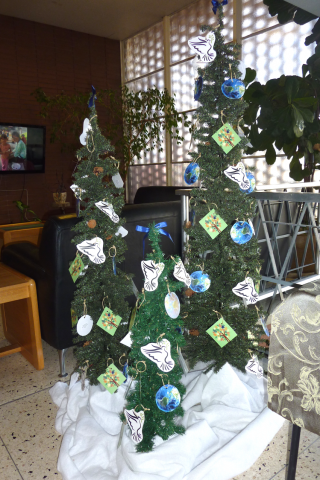
MCS is sponsoring 3 families through The Neighborhood House. The first two families are single moms who have fallen on some hard times and the third family is a family whose mother has terminal cancer and they expect this to be their last holiday season together. We have three trees set up in the MCS Lobby. Each tree is adorned with ornaments. On the back of the ornaments is a family, family member, and their wished for gift.


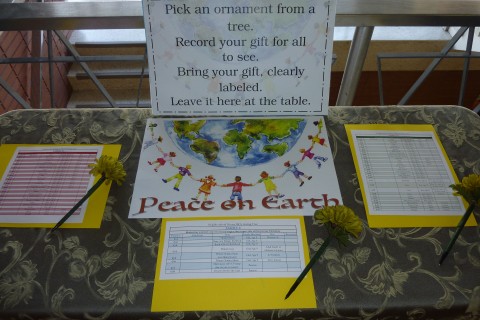
We have broken up the families to: Family A, Family B, and Family C. On the table next to the trees are complete lists. Please fill out what ornaments you drew on these lists so we can more easily track what is being donated. We encourage you to involve your students in this process. All donated items must be to MCS no later than Thursday, December 10th.

The Neighborhood House has been helping and supporting children and families in our community since 1894. It was founded with the goal of serving underprivileged children, to raise the standard of living, and to provide food and clothing when necessary. Neighborhood House exemplifies the ideals of an early settlement house. They have a strong history of bringing individuals, families and community together. From the very beginning, they have embraced their neighbors, celebrated Utah’s many cultures, and connected families to cultural and community resources in our community. Throughout their rich history, one thing has always remained constant: providing quality care for low-income families based on their ability to pay. More information can be found here: nhutah.org


Spring Pizza Mondays

Session 2 of Pizza Mondays will be starting on Monday, January 11th. The session will run from January 11th through May 23rd, excluding January 18th, February 15th, and March 21st when the school will be closed. A pizza lunch will include seasonal fruits and vegetables and your choice of pizza.

Please submit completed form, with payment in full, to the office by Wednesday, January 6th for your student to participate in the first Pizza Monday. Any changes to a pizza order must be made by no later than the Thursday before the change is to take effect.

You may place an order anytime between January 11th and May 23rd, but please be sure to prorate the total amount due. All Checks should be made payable to Montessori Community School, or MCS.

Raising your Montessori Child

As Montessori parents, we are giving our children a great gift that does not just start at 8:30am and end at 3pm.  This gift should be nurtured, honored and recognized at all times, particularly in the home. Donna Bryant Goertz wrote one of my favorite Montessori books about classroom management in the Lower Elementary classroom, ‘Children Who are Not Yet Peaceful’. This book highlights the value of community and truly honoring and trusting each child to develop in their time, in their way, and in absolute authenticity.  It is powerful and inspiring for educators and parents and I highly recommend it to those of you who are raising Lower Elementary age children or who will be doing so in the near future. However, its values are appropriate for children, parents, and educators of all ages.

In her book, Donna presents some wonderful tips for how to best support children in the home.  Family life for the [early elementary] child should include as many of the following elements as possible:

  • A slow-paced lifestyle with long hours of sleep on a regular schedule, a nutritious diet high in protein and fresh fruits and vegetables, plenty of exercise, and a generous amount of time in nature.
  • Someone to behold the child’s face with joy, hold her, hug her, and treasure her for herself alone.
  • Someone to read chapter books aloud for twenty to thirty minutes every day, at a level three years beyond the child’s reading level.
  • Someone to recite poetry every day, a new poem each week.
  • Someone to sing every day, a new song each week.
  • Someone to tell delightful stories of the child’s own life.
  • An atmosphere of open curiosity and inquiry, in which everyone in the family treasures learning.
  • Responsibility for caring for himself and his own things as well as contributing to meal preparation and the care of the house, garden and pets.
  • A two hour weekly limit on all screen media – movies, videos, TV, and computer games combined.
  • Freedom from being dragged around on errands.
  • Freedom from the cynicism and sarcasm appropriate to later years.
  • Parents who say no cheerfully and mean it.
  • Parents who wait until their children are in bed to listen to music, watch movies, play computer games, and watch TV programs, even the news, that are not appropriate to the children’s ages or that would give the children more media hours that is best for the development.
  • Parents who establish and uphold a family child-rearing culture that is appropriate to the child’s age and who support age-appropriate independent thought and action and an age-appropriate role in decision making in as many areas and as often as possible.

TEN TIPS FOR SUPPORTING YOUR CHILD AT HOME:

  1. Prepare every room of your home so your child can participate fully in family life. Example: Solicite your child’s help in creating a menu, stock the pantry and fridge with food they are allowed to eat, give your child a lesson on how to serve themselves from start to end, including the clean up process, set them up for success.
  2. Differentiate carefully between age-appropriate and age-inappropriate participation in family life. Example: Be clear about the movies, games, etc. they are allowed to view and why those are appropriate.  Stand your ground.
  3. Include the child in plans if you don’t want a bored child on your hands. Example: Before you make a new purchase, such as a new dishwasher, show her the features you are looking for, the price range, etc. and allow her to help you while at the store.  Consider giving her a clipboard for note taking, listen to her opinions and explain when, why and how you are making your purchase decision.
  4. Organize family life to fit the needs of your child’s age and personality. Example: Organize a bedtime ritual that is appropriate for your child’s personality and respect that routine regularly. Avoid variations of schedules and consider individual needs.
  5. Welcome all feelings and help your child to express strong emotion with clarity and respect. Example: Give your child appropriate language.  “I can see you are angry and I understand how being excluded from your brothers play date can be frustrating. You wish they would include you.  Have you thought of a way you can express your desire in a way that might make your brother want to include you?”
  6. Explain carefully what’s going on in the family, while staying on an age-appropriate level in keeping with your child’s understanding and interest. Example: Mommy and daddy are speaking in private often because we are concerned about your brothers school work.  We want to talk about ways we can help him and although we are all upset, we love each other no matter what.”
  7. Maintain cycles of activity in balance with basic needs for nutrition, sleep, exercise, quiet concentration, solitude, and companionship that fit your child’s temperament. Example: If your child fights with a particular friend during a play date, together make a carefully organized plan for the play date.  Consider how they will spend their time, what they will do if they have conflict, etc.
  8. Participate three times a day with your child straightening his room and bath and putting away his toys, materials and games. Example: Keep only one-tenth of your child’s possessions neatly stored and handsomely displayed on shelves. Store the others away and rotate the possessions about once a month, with your child’s help, allowing them to choose what is unpacked.
  9. Treat your child’s behavior as “in process” and developmental, never simply as good or bad. Example: Avoid praise and stick to acknowledgement. ” I noticed you were so mad and Sandy and you yelled instead of hitting, that shows great impulse control.” “I see you threw your socks in the laundry, that is very responsible. Soon you will place all of your clothes in the laundry.”
  10. Balance firmness and consistency with a generous measure of hopefulness, good cheer, and joy. Laugh a lot. Tell wonderful little stories of your child’s life, often. Example: Calmly and quietly put away your child’s bike and make it unavailable to him when he leaves it out in the rain again. Make a date for buying wax and showing him how to repair it before he uses it again. Have fun together repairing the bike and laugh and take pictures of one another, don’t focus on the mistake. Remind your child, “Next week when you put your bike away every day, we will ride to the park together.”

Basic Herbology and Practical Potions

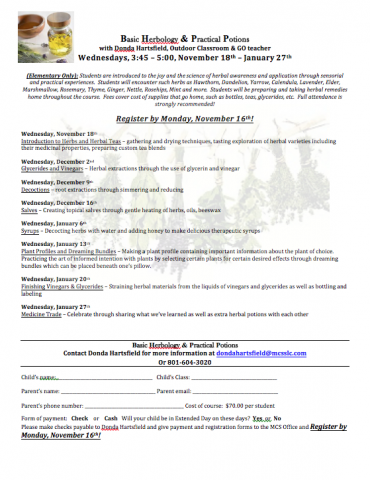
Basic Herbology & Practical Potions

with Donda Hartsfield, Outdoor Classroom & GO teacher

Wednesdays, 3:45 – 5:00, November 18th – January 27th


(Elementary Only): Students are introduced to the joy and the science of herbal awareness and application through sensorial and practical experiences.  Students will encounter such herbs as Hawthorn, Dandelion, Yarrow, Calendula, Lavender, Elder, Marshmallow, Rosemary, Thyme, Ginger, Nettle, Rosehips, Mint and more.  Students will be preparing and taking herbal remedies home throughout the course.  Fees cover cost of supplies that go home, such as bottles, teas, glycerides, etc.  Full attendance is strongly recommended!


Register by Monday, November 16th!


Wednesday, November 18th

Introduction to Herbs and Herbal Teas – gathering and drying techniques, tasting exploration of herbal varieties including their medicinal properties, preparing custom tea blends


Wednesday, December 2nd

Glycerides and Vinegars – Herbal extractions through the use of glycerin and vinegar


Wednesday, December 9th

Decoctions – root extractions through simmering and reducing


Wednesday, December 16th

Salves – Creating topical salves through gentle heating of herbs, oils, beeswax


Wednesday, January 6th

Syrups – Decocting herbs with water and adding honey to make delicious therapeutic syrups


Wednesday, January 13th

Plant Profiles and Dreaming Bundles – Making a plant profile containing important information about the plant of choice.  Practicing the art of informed intention with plants by selecting certain plants for certain desired effects through dreaming bundles which can be placed beneath one’s pillow.


Wednesday, January 20th

Finishing Vinegars & Glycerides – Straining herbal materials from the liquids of vinegars and glycerides as well as bottling and labeling


Wednesday, January 27th

Medicine Trade – Celebrate through sharing what we’ve learned as well as extra herbal potions with each other


Basic Herbology & Practical Potions

Contact Donda Hartsfield for more information at dondahartsfield@mcsslc.com

Or 801-604-3020


Child’s name:___________________________________________   Child’s Class: ______________________________________


Parent’s name: __________________________________________ Parent email: ______________________________________


Parent’s phone number: ____________________________________________ Cost of course:  $70.00 per student


Form of payment:   Check    or    Cash   Will your child be in Extended Day on these days?  Yes  or  No

Please make checks payable to Donda Hartsfield and give payment and registration forms to the MCS Office.
Register by Monday, November 16th!

MCS Halloween Carnival 2015

S would like to extend our deepest gratitude to all of the parents, grandparents and other community members who worked together to make our Halloween Carnival such a smashing success.  Thank you to those who came out to play and enjoy this great event with all of us. And, congratulations to the Uinta class on the success of their first Spook Alley.

An Early Childhood Aspens class student smiles for the camera.

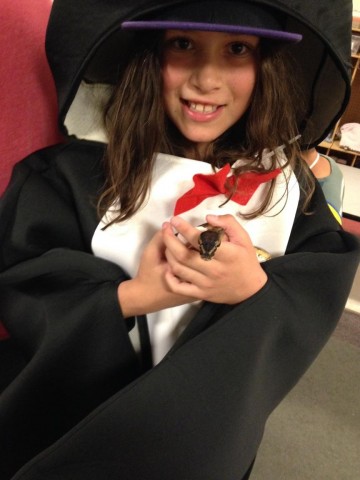
As always, the reptiles and other creatures were a huge draw, exciting children and adults all throughout the night.

Two families with students in the Magnolias class enjoy the trunk-or-treat in the parking lot.

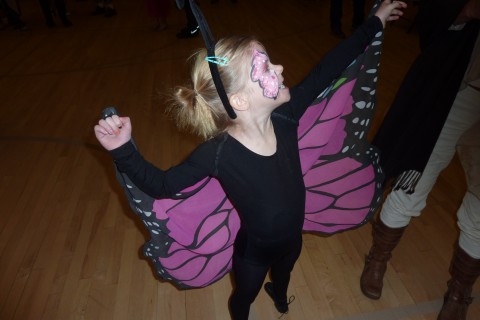
This Early Childhood student had a great time showing off her wings all night.

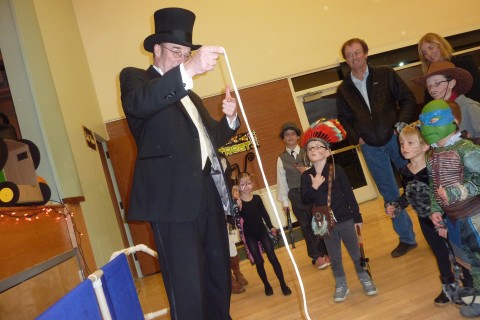
We had a great time watching the magician.

Hey Chris!