Author: Alejandro Malespin

All School Science Assembly – SCIENCE IS COOL!

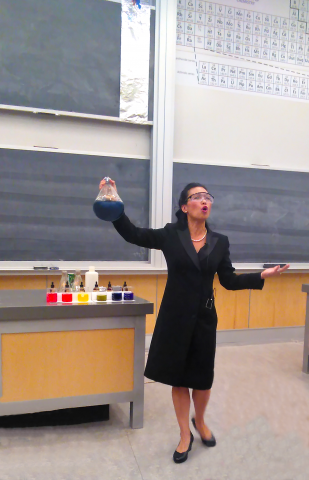
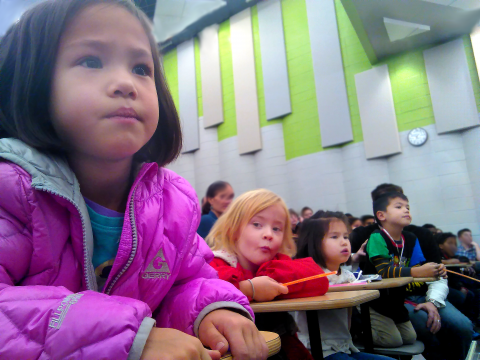
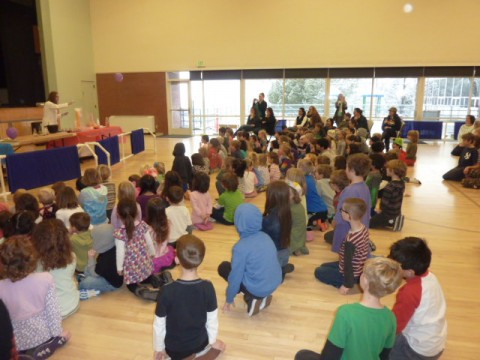
Wow, what a great morning here at MCS! First thing this morning, our entire staff and student body came together for a wonderful assembly.  We began by singing one of our favorite peace songs, Light A Candle for Peace, and then two MCS parents gave a wonderfully exciting science presentation.  It was so lovely to see all of our students, from our young Toddlers to our big Upper Elementary students, show excitement and interest in the experiments.


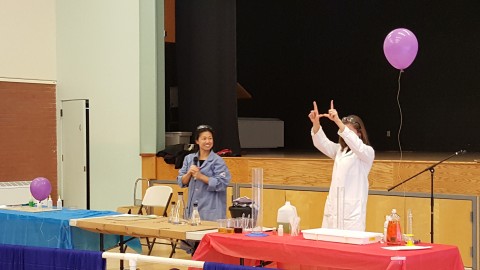
Janis Cantwell, research scientist at the University of Utah, and Holly Sebahar, Professor of Chemistry at the University of Utah, both parents of Early Childhood students, showed the following experiments of chemical reactions; the effects of a catalyst; things that changed from liquid to solid and the formation of stronger bonds; liquids changing colors and bubbling and smoking; how fireworks work; what hydrogen looks like when popping from a balloon as opposed to helium; and for the grand finale, Holly made a cloud!


It was so satisfying to see all of our students enjoying the presentation and we are all looking forward to the upcoming Science Fair on April 7th.  After today’s presentation we think our little scientists are quite inspired!

Be sure to visit our Facebook page to see videos from this mornings experiments!

PSA Mission

PSA Mission

The Montessori Community School Parent School Alliance (PSA) works in partnership with the MCS Administration and Staff to help strengthen, support, and empower our community of students, teachers, staff and families. We achieve this by executing the following pillars:

Collaboration: We work together with the mission to offer support to the school, which allows our children to get the most out of their education. We work in partnership with a wide array of individuals and organizations to accomplish our defined goals of community building.

Commitment: We are dedicated to promoting children’s educational success, health and well-being through strong parent, family, and community involvement.

Respect: We value our children and ourselves. We expect the same high quality of effort and thought from ourselves as we do from others.

What’s The Big Deal About Kindergarten?

This is the time of year when many parents, particularly those of children with second year Early Childhood students, are faced with deciding where their child will attend school for the coming year(s). Kindergarten can seem like a natural transition to a local public school or an elementary program you may have had your eye on for some time.  However, the third year in an Early Childhood program is a very magical experience that we hate to see our students missing out on.  Below is an article written by Tim Seldin and Dr. Elizabeth Coe, experienced Montessori teachers, parents, trainers and advocates, about the benefits of kindergarten in a Montessori environment.  

Why Montessori for the Kindergarten year?

By Tim Seldin with Dr. Elizabeth Coe
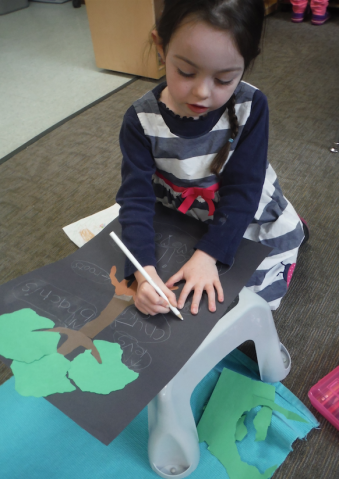
Magnolias Third Year student works on a botany project.

It’s re-enrollment time again, and in thousands of Montessori schools all over America parents of
four-almost-five-year-olds are trying to decide whether or not they should keep their sons and
daughters in Montessori for kindergarten or send them off to the local schools.

The advantages of using the local schools often seem obvious, while those of staying in
Montessori are often not at all clear. When you can use the local schools for free, why would
anyone want to invest thousands of dollars in another year’s tuition? It’s a fair question and it
deserves a careful answer. Obviously there is no one right answer for every child. Often the
decision depends on where each family places its priorities and how strongly parents sense that
one school or another more closely fits in with their hopes dreams for their children.

Naturally, to some degree the answer is also often connected to the question of family income as
well, although we are often amazed at how often families with very modest means who place a
high enough priority on their children’s education will scrape together the tuition needed to keep
them in Montessori.

When a child transfers from Montessori to a new kindergarten, she spends the first few months
adjusting to a new class, a new teacher, and a whole new system with different expectations.
This, along with the fact that most kindergartens have a much lower set of expectations for fiveyear-olds
than most Montessori programs, severely cuts into the learning that could occur during
this crucial year of their lives.
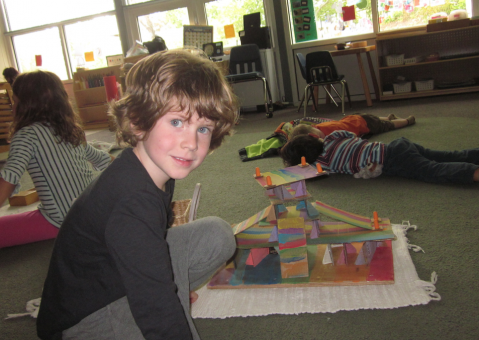
This Sequoias Third Year Student gets creative. 

Montessori is an approach to working with children that is carefully based on what we’ve learned
about child development from several decades of research. Although sometimes misunderstood,
the Montessori approach has been acclaimed as the most developmentally appropriate model
currently available by some of America’s top experts on early childhood and elementary
education. As a “developmental” approach, Montessori is based on a realistic understanding of
children’s cognitive, neurological and emotional development.

One important difference between what Montessori offers the five-year-old and what is offered
by many of today’s kindergarten programs has to do with how it helps the young child to learn
how to learn. A great deal of research shows that quite often students in traditional programs
don’t really understand most of what they are being taught. Harvard Psychologist and author of
The Unschooled Mind, Howard Gardner, goes so far as to suggest that, “Many schools have
fallen into a pattern of giving kids exercises and drills that result in their getting answers on tests
that look like understanding.”

But several decades of research into how children learn have shown that most students, from as
young as those in kindergarten to students in some of the finest colleges in America do not, as
Gardener puts it, “understand what they’ve studied, in the most basic sense of the term. They lack
the capacity to take knowledge learned in one setting and apply it appropriately in a different
setting. Study after study has found that, by and large, even the best students in the best schools
can’t do that.” (On Teaching For Understanding: A Conversation with Howard Gardner, by Ron
Brandt, Educational Leadership Magazine, ASCD, 1994.)

Montessori is focused on teaching for understanding. In a primary classroom, three and fouryear-olds
receive the benefit of two years of sensorial preparation for academic skills by working
with the concrete Montessori learning materials. This concrete sensorial experience gradually
allows the child to form a mental picture of concepts like “how big is a thousand, how many
hundreds make up a thousand”, and what is really going on when we borrow or carry numbers in
mathematical operations.

The value of the sensorial experiences that the younger children have had in Montessori is often
under-estimated. Research is very clear that this is how the young child learns, by observing and
manipulating his environment. The Montessori materials give the child a concrete sensorial
impression of an abstract concept, such as long division, that is the potential foundation for a
lifetime understanding of the idea in abstraction. Because Montessori teachers are
developmentally trained, they normally know how to present information in an appropriate way.
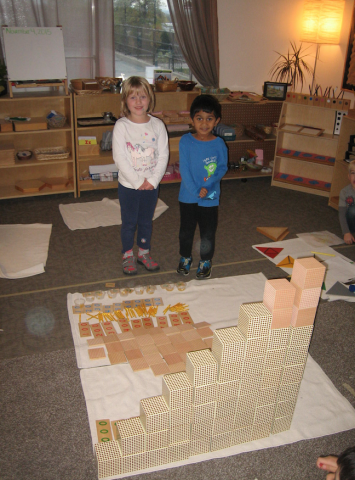
 

Third Year Students from the Willows Class lay out the decimal system in preparation for adding, subtracting, multiplying and dividing in to the thousands.

What often happens in schools is that teachers are not developmentally trained and children are
essentially filling in workbook pages with little understanding and do a great deal of rote
learning. Superficially, it may appear that they have learned a lot, but the reality is most often
that what they have learned was not meaningful to the child. A few months down the road, little
of what they “learned” will be retained and it will be rare for them to be able to use their
knowledge and skills in new situations. More and more educational researchers are beginning to
focus on whether students, whether young or adult, really understand or have simply memorized
correct answers.

In a few cases, kindergarten Montessori children may not look as if they are not as advanced as a
child in a very academically accelerated program, but what they do know they usually know very
well. Their understanding of the decimal system, place value, mathematical operations, and
similar information is usually very sound. With reinforcement as they grow older, it becomes
internalized and a permanent part of whom they are. When they leave Montessori before they
have had the time to internalize these early concrete experiences, their early learning often
evaporates because it is neither reinforced nor commonly understood.
In a class with such a wide age range of children, won’t my five-year-old spend the year taking
care of younger children instead of doing his or her own work? The five year olds in Montessori
classes often help the younger children with their work, actually teaching lessons or correcting
errors. Many Montessori educators believe that this concern felt by some parents is very
misguided.

Anyone who has ever had to teach a skill to someone else may recall that the very process of
explaining a new concept or helping someone practice a new skill leads the teacher to learn as
much, if not more, than the pupil. This is supported by research. When one child tutors another,
the tutor normally learns more from the experience than the person being tutored. Experiences
that facilitate development of independence and autonomy are often very limited in traditional
schools.

By the end of age five, Montessori students will often develop academic skills that may be
beyond those of advanced students. Academic progress is not our ultimate goal. Our real hope is
that they will feel good about themselves and enjoy learning. Mastering basic skills is a side
goal.

Montessori children are generally doing very well academically by the end of kindergarten,
although that is not our ultimate objective. The program offers them enriched lessons in math,
reading, and language, and if they are ready, they normally develop excellent skills. The key
concept is readiness. If a child is developmentally not ready to go on, he or she is neither left
behind nor made to feel like a failure. Our goal is not ensuring that children develop at a
predetermined rate, but to ensure that whatever they do, they do well and master. Most
Montessori children master a tremendous amount of information and skills, and even in the cases
where children may not have made as much progress as we would have wished, they usually
have done a good job with their work, wherever they have progressed at any given point, and
feel good about themselves as learners.
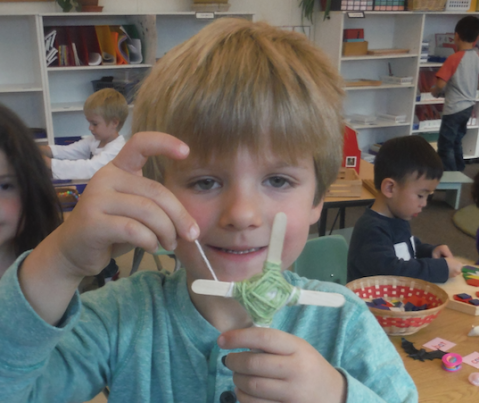
 

This Third Year Student from the Aspens class refines his small motor skills in the Practical Life area. 

About the Authors

Dr. Elizabeth (Betsy) Coe is the Past President of the American Montessori Society and Director
of the Houston Montessori Teacher Education Center in Houston, Texas.

Tim Seldin is the President of the Montessori Foundation and Headmaster Emeritus of the Barrie
School in Silver Spring, Maryland.
 

Chaperoning During Winter Sports

Chaperoning during Winter Sports is a great way to get your Parent Volunteer Hours in. It is also challenging, rewarding, and a lot of fun; however, there are certain guidelines and expectations to adhere by.

Firstly, as a Winter Sports Program Chaperone you will have multiple duties. These duties include helping to keep the peace and monitor the students for safety issues and concerns. Some safety issues to keep in mind while chaperoning are:

  • Head Counts: Please keep a sharp eye on the students coming and going from the school to the bus, bus to the Cottonwood Room, Cottonwood Room to the restrooms, etc.
  • Please ensure all students are wearing their helmets and goggles. If a student has forgotten one of those items, please let the two Winter Sports Program representatives know and they, in turn, will get that item from an instructor.
  • If following a Ski School Group on the mountain, please ensure the youngest children wearing yellow aprons are riding the lifts with an adult.
  • Have a clear understanding of which children you are in charge of carries and/or uses an Epi-Pen and/or Inhaler. (Each week prior to leaving the school, you will be briefed on this information).
  • Help the students to listen and be respectful, by being the example- please no jabbing on the phone if you are to be watching the students.

Other expectations as a Winter Sports Parent Chaperone are as follows:

  • Please let the students do as much as possible by themselves: this includes loading and unloading their gear.
  • Please do not purchase hot chocolate or any item for the students while away.
  • Please allow the students time to socialize with each other on the bus and not with your personal electronic devices.
  • Follow all directions from the ski instructors and not interrupt or critique the instructors or the lesson. If you have concerns with an instructor or the lesson, please let one of our two representatives know upon your return to the school.
  • Help the students to support their peers and use teamwork.
  • Talk with the students about the lesson and emphasis the importance of skills-refining. Try to steer conversations away from a “leveled system”.

As the program draws near, each Parent Chaperone will be contacted with more specific details and a timeline. If you have questions about chaperoning, please contact the MCS Office.

All School Science Assembly

Janis Cantwell presenting at the University of Utah’s Faraday Chemistry Lectures

This Spring our Elementary students will participate in a Science Fair. To gear up for the fair, we will be hosting an All-School Science Assembly. We will have Janis Cantwell, Early Childhood parent to triplets, no less, and the Hostess to the University of Utah’s Faraday Chemistry Lectures presenting along with co-worker, Holly Sebahar, Early Childhood parent.


We are excited to be able to get together as an entire school “family” and celebrate each other and reconnect with the diversity of students across programs. We speak so often of community building and this is one way the youngest children get to see and interact with the oldest children. It is also a wonderful for the teachers to be able to all be together with their students and each other as a whole group. The Faraday Chemistry Lectures are fabulous, exciting, and entertaining and a sure way to get your student thinking about science. Our assembly does not come complete with a full chemistry lab, however, we are sure our mini version will be one your students will be excited to tell you about! The assembly will take place January 20th at approximately 9:20 am.

Some of our Early Childhood students enjoying the chemistry taking place!

Admissions Information Meeting – Open to the Public

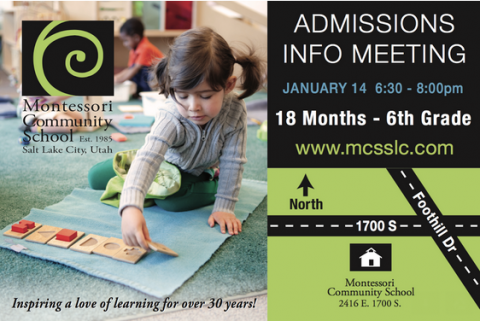
Montessori Community School will be hosting an Admissions Information Meeting for all adults interested in learning more about any of our programs for 2016-2017 Admissions.  Parents are invited to join us for a presentation about Montessori method, curriculum and philosophy and how they are implemented in our program to educate the whole child. Then, visit individual classrooms to learn more about each program and to meet and greet with our administrative and teaching staff.  2016-2017 Application Packets will be available.

  • Meeting starts promptly at 6:30pm
  • Adults only – sorry, no child care provided
  • Bring a friend!


Unable to attend this event?  Contact the school at info@mcsslc.com to schedule a tour.

SNOW DAY – School Closing Early

Based on the weather forecast we will be having an early closure today. Please pick up Elementary children by 3:00pm and Toddler and Early Childhood children by 3:30pm.

As many of our students will be absent and some of our staff have been unable to make it to the school due to poor road conditions, regular classes will not be held and alternative activities will be offered and some classes will probably combine for the day.

1700 South is in very poor condition so we advise you to avoid traveling to the school if you are able to keep your children home for the day.
Stay warm,

MCS Administration

SNOW DAY – School closure

SNOW DAY: please do not bring your kids to school today. Many of our staff members are unable to make it to the school due to poor road conditions.

While there are limited staff on site – since the snow has not been plowed from 1700 S. normal class will not be held because of our staff limitations. We will update this post if something changes.

Holiday Giving Gives Back

This year, MCS sponsored three families through The Neighborhood House, a local charity. We started with three small trees filled with ornaments, each depicting a special wish list items. Over the last couple of weeks we have watched our students and families become excited, tearful, and deeply involved with this project.


We were overwhelmed with the response. Within the first week, all the ornaments were taken and we were being asked, “What else can we bring in? What else can we do?”. We then contacted The Neighborhood House and got another list of items they are constantly in need of. We made more ornaments, and within two more days, those ornaments were taken and wishes were fulfilled.


Today, our 3rd Year Lower Elementary students were able to deliver the gifts to The Neighborhood House. They were so excited to unload the gifts and bring them into the building. They watched as children gathered at doorways and windows smiling with glee just seeing the many beautiful gifts being brought in.

During the drive to the charity, the students carried on a heartfelt conversation about the gifts, and how they are going to families that really need the items and families that don’t have hardly anything. It was touching to see their connection to this event, their understanding, and compassion. We are so blessed here in our community at this school. We are feeling so grateful and our hearts are full in wonderment at our MCS families and their brilliant children.


Thank you to our wonderful PSA in coordinating, and communicating with The Neighborhood House to be able to become involved in such a beautiful program. We hope this grace continues on with everyone this season and into the new year.