Author: Alejandro Malespin

Talking to Kids about Puberty, Sex and so much more!

We are waist deep in raising teenagers at our house so conversation about bodies, puberty, consent, respect for others, and sex are fairly common. But the conversations didn’t start yesterday. We’ve been talking in age appropriate terms since my children were toddlers. We’ve kept a variety of age appropriate books laying around the house to allow the boys to do their own research, as needed. My personal philosophy is that the more I talk openly, even during the stages or about topics that have been slightly uncomfortable for my kids, the more they will see me as a resource when their questions arise. There are too many resources at their fingertips that aren’t necessarily trustworthy and I believe sex and body shame are two of the most avoided topics in homes.

Sometimes, especially when my kids were upper elementary and middle school age, they would tell me that the topic was irrelevant or embarrassing.  While puberty can be an exciting transition, it can also be really weird to talk to your mom or dad about. I have found that short, concise explanations about things during casual conversation is a great way to get through during these stages.  On the occasion that one of my kids has told me that the topic was embarrassing or irrelevant I politely thank them for listening and remind them that I just want to make sure that they know that, even though it might be embarrassing for them, it’s not embarrassing for me and when the time is right and they *do* want someone to talk to, I will be there.

Below are some great resources to support parents and students aged 9 and up, as 9 years old tends to be the time when many kids prefer to avoid these conversations with parents AND when some noticeable body changes start to take place. It’s important to determine, based on your families needs, the right time, topics and atmosphere for opening these conversations in the home and to ensuring our kids don’t experience shame about their bodies. When all else fails, leaving age appropriate books around the house has proven an effective form of education in many homes.

  • The Care and Keeping of You: The Body Book for Younger Girls (8 and up), Valorie Schaefer (Author), Josee Masse (Illustrator)
  • The Care and Keeping of You 2: The Body Book for Older Girls (10 and up), Cara Natterson (Author), Josee Masse (Illustrator)
  • It’s Perfectly Normal: Changing Bodies, Growing Up, Sex, and Sexual Health (The Family Library) Robie H. Harris and Michael Emberley
  • Does This Happen to Everyone?: A Budding Adult’s Guide to Puberty Jan von Holleben, Antje Helms
  • “What’s Happening to Me?” A Guide to Puberty Peter Mayle, Arthur Robins (Illustrator), Paul Walter (Illustrator)

Silent Journey & Discovery – An Invitation to FMSL Parents to Enjoy the Magic of Montessori

The MCS Silent Journey and Discovery is an event dedicated to parents to provide the meaningful experience of visiting each of our programs, from Toddlers through Upper Elementary. We invite you to experience for yourself the magic of the Montessori materials and discover how the lessons learned in our early programs set the tone and lay an important foundation to prepare students for higher academics and critical thinking skills in the upper programs. This is a wonderful opportunity to gain a sense of how the Montessori Curriculum unfolds through the eyes of a child to guide and nurture the natural unfolding of the whole child to inspire a lifetime love of learning and peace.

Who: All MCS Parents Invited
When: Saturday, January 26, 2019 @ 9:00am – 1:00pm
Where: Meet in the MCS lobby
Cost: Attendance is free of charge
Child Care: Child care will be provided to those who sign up in advance

Lunch will be served.

Sign up in the office, space is limited.

Wondering what you might get out of attending this year’s Silent Journey and Discovery? Below are some experiences shared by attendees of the past…
We hope you can join us this year!!!

Thanks very much to the MCS staff who led us on our Silent Journey. When I walked into the lower and upper el classrooms in particular, I felt like a kid in a candy store. I couldn’t wait to get my hands on everything I could see. The kids are so lucky to be able to learn in such engaging, tactile, and visually stimulating ways that are tailor-made for their stage in life. I found myself pining for those days when I could explore just for the fun and education of it. Sitting at a computer 8 hours a day denies me that visceral interaction and electrifying feedback that comes with it. The contrast between their day and mine has helped me to realize how enriching their education has been over the years, and that there is a hole in my working life that needs to be filled. My hope is that the kids’ experiences are germinating a healthy, persistent hunger for knowledge and enrichment that will last them a lifetime. Congratulations on a well done journey.

Julie Kiefer, MCS parent

“I just wanted to thank you again for the wonderful silent journey and discovery on Saturday. When I originally chose Montessori for Luka at age 3, I read the book Understanding Montessori, but this was the first chance I’ve had to personally work with Montessori materials. Everything I saw on Saturday validated my choice for Luka’s education and in particular my choice of Montessori Community School. The environments are beautiful and so well-prepared and the teachers are well spoken advocates and role models for little people. Bravo!”

Karna Sacchi

“Our little girl started this October in one of the Toddler classes. We felt and understood how this would be a good environment for our daughter–we saw a difference in her after only a week! The only thing to say after experiencing Silent Journey is we THOUGHT we understood how good of an environment this is for our daughter. The progression through the classrooms and the works is absolutely brilliant. There is no way we would want anything different for our precious little girl. The system set in place is orderly, focusing on progression, growth, and learning pertaining to independence, reading, math, social skills, morals, ethics, and problem solving. We noticed how ‘hands on’ and multi faceted every work is designed to engage the children on their level with their own learning abilities and processes.

We were also so impressed with the educators- the individual time, care, and attention they put into their students. They truly know and understand each individual child they work with.

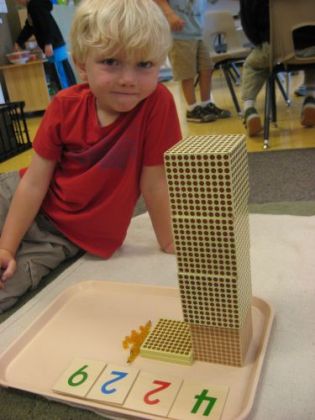
We discovered how the works build. The one that stuck out to us the most was the math. Starting early with dimensions, and stacking blocks moving toward cubes and counting- and onto multiplying enormous numbers by using a mat and beads- Absolutely incredible.

Math was a subject I struggled with and I can remember the exact time (2nd grade) when I got left behind. We had to pass off times tables with the teacher in front of the whole class. I was too shy and embarrassed to perform those simple times tables in front of the class for fear of getting them wrong or not being able to have them memorized the way all the other kids seemed to be able to do. I struggled the rest of my life with the ominous subject. During Silent Journey, when I reached Lower Elementary, I got it. I actually got a little emotional watching and doing the hands on mathematics. Both my husband and I just kept saying that we wished we would have had this type of learning environment available to us as kids.

We know the school is expensive; however, we walked away from Silent Journey thinking it is worth every penny and we would pay it twice over to have our children here. In our minds, there is no other way that can hone in on every aspect of learning for each individual child and still be able to provide loving, passionate, engaging teachers to foster a child’s learning and progression. Thank you so much for this amazing opportunity and for this incredible school. You really do ‘get it’ here. “

Anonymous

“The Silent Journey and Discovery was a very emotional and powerful experience for me. I did not attend a Montessori school as a child so I am only familiar with the Montessori philosophy through what I have read and observed in the last two years. It gave me a great appreciation and understanding of the different developmental levels of the works. I loved seeing the progression and advancement of the works through Toddler, Early Childhood and up through Middle School. The grammar and math works were thrilling to learn and experience. The focus on the sensorial aspects of each work creates a love of learning. In addition to receiving an amazing education the students are also learning how to be independent, respectful and loving human beings. I think every MCS parent should participate in the Silent Journey and Discovery to really understand and appreciate the experience and education we are giving our children. I know that it made me realize that I will do everything in my power to continue my daughter’s Montessori education.”

Tonia Hashimoto

“Having not grown up in a Montessori environment, it has been difficult for me to understand what exactly a day in the life of my Montessori students is like. I try to take in as much as I can at pick-up and drop-off, with the occasional visit and guided lesson by my children, but there is no way to fully understand without an experience like the Silent Journey and Discovery. It was an eye-opening voyage that I would recommend for every parent, and prospective parent. I want to do it again.

Going through a classroom from each cycle really makes the whole Montessori experience come full circle from seeing how the Toddlers get their first understanding of space and shape, to Early Childhood and their practical life lessons, to Lower Elementary and their grammar materials which encourage socialization, to the Upper Elementary complex math problems, to a Middle School student-led Socratic discussion. We only saw the tip of the iceberg, but the hands-on learning experience helped personify the school life of our children. I was struck by the thoughtful organization of each room; how comfortable and serene a small space can feel.

I also enjoyed the roundtable discussion following our classroom journeys. We were able to get some insight from teachers, staff, students and other parents. Because Montessori isn’t the “traditional” schooling for kids in our country, there are obvious concerns and hesitations with going outside the “norm”. Many of my concerns were put to ease and I feel my children are on the correct path for them at this time. I appreciated the book recommendations and feel they will help in understanding the Montessori Method and perhaps assist me with decisions for my family down the road.

My kids have been at MCS for three/four years now and I feel like I have finally been able to look beyond the curtain of their daily journey, something that every parent should see and experience. Now, when my kids and I have our chats at the end of the day, I can ask even more detailed questions and have a bit more understanding as to how their day went. That is priceless.

Thanks again to all who helped facilitate the Silent Journey and Discovery.”

Carrie Christensen

“I think it should be mandatory that every parent go through silent journey! Even though Aria has been here for 7 years, Azur 3 years, and I have taught art on and off during all of that time, I never really got it as I did Saturday. Suddenly, all that I had read about Montessori or observed in the classrooms made sense. It builds on itself in a beautiful way as the student moves from one phase to another. I loved seeing how things made sense in a concrete way and then transitioned towards abstraction. I’m so honored to provide my children with this opportunity.”

Kindra Fehr

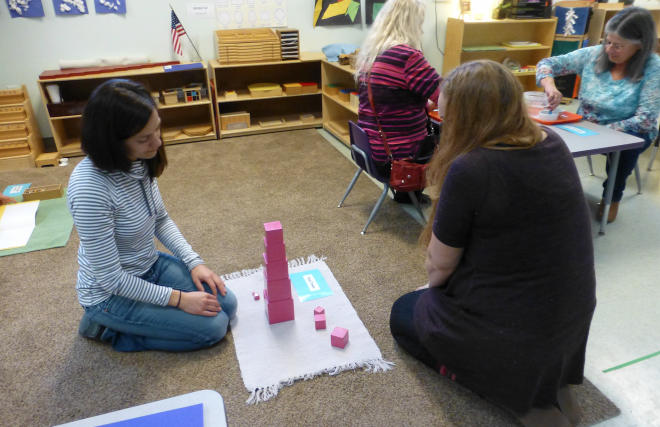
Examining the Pink Tower in an Early Childhood Classroom
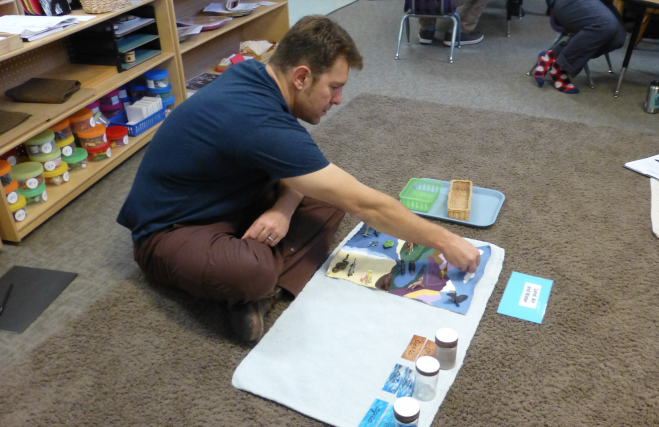
Land, Air, Water in an Early Childhood classroom
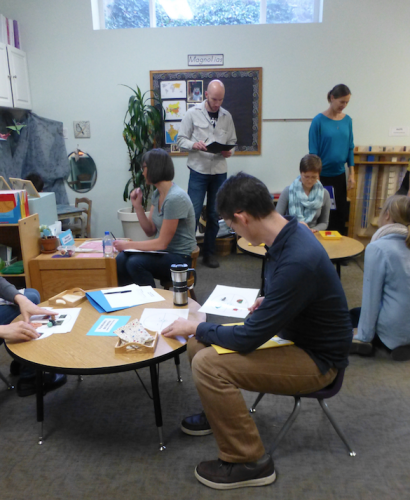
A group of parents explore an Early Childhood classroom
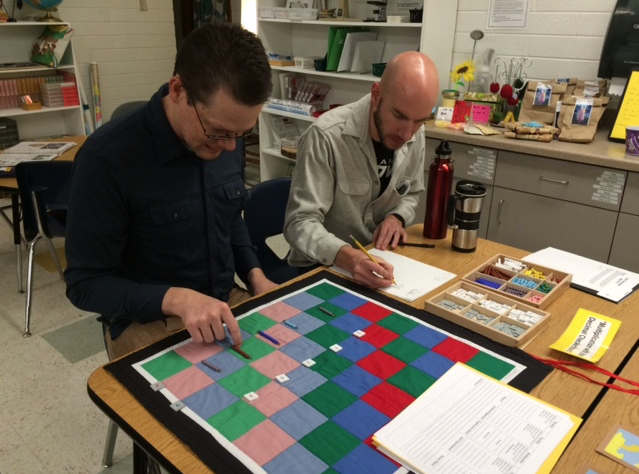
Elementary teachers, Bonnie and Margaret, teach a lesson on Test Tube Division – a material used to teach long division
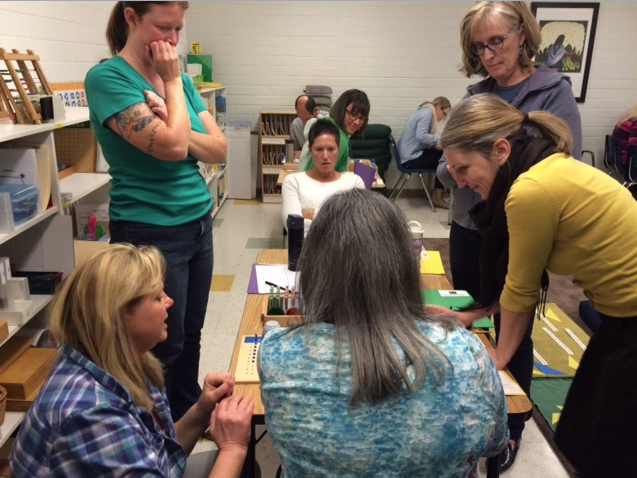
Two parents explore math in Elementary

Thank You- FMSL’ Holiday Giving Projects Wrapped Up

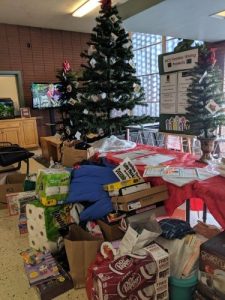
Thank you so much to all those who participated in our annual Holiday Gift Giving, particularly our PSA for helping to put the whole thing together and our elementary students for helping to carry and load so many of the gifted items.

This year we donated to three different organizations; The INN Between, International Rescue Center (IRC), and The Neighborhood House. We were able to fill every
request because of the amazing and generous support of our community.

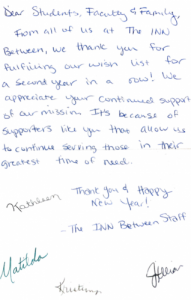
We received a wonderful thank you note from the INN Between House, whose mission is to end the tragic history of vulnerable people dying on the streets of our community by providing a supportive and safe haven for individuals who have nowhere else to go in time of medical crisis.
Our School Director, Britney Peterson, and her family were able to deliver the gifts to the family assigned to FMSL from the IRC who needed a little help for the holidays. Britney said, “This experience was the most amazing thing that her family has ever done.” She also said that it was a wonderful opportunity, and that it was such a special experience for all of her children to be a part of. We hope each of you and your students who helped shop for gifts were able to feel a special connection to the love and peace that comes from thinking of, giving to, and sharing with others in our community.
Thank you so much for being willing to support us as we strive to support our community!

Montessori Education Foundation Funds and Gifts

Thanks to your generosity during our Fun Run Drive this past Fall to our non-profit Montessori Education Foundation (MEF). We were able to send or order the following items to our sponsored Navajo Grandmothers this week through the Adopt-a-Native Elder Program.


Mothers Day Box-
Spring Delivery only and delivered during the Spring food run. This gift box fills a need to provide personal care items that are not contained in any other gift option. It contains Cottenelle wipes, Kleenex, a wash cloth, bath towel, vent brush, bobby pins, Vaseline, shampoo, sanitizer, emery boards, and a bandana.
Grandmother Box –
This box contains 3 yards of Panne fabric and 4 yards of cotton fabric for making a skirt and blouse. Also included are safety pins, socks, scarf, thread, yarn, and a hygiene kit. The price of this item includes a credit card charge.
Food Certificates that can be used at all Bashas grocery stores located throughout the reservation. The certificates can only be used to purchase food and off-the-shelf medical items. They cannot be used for alcohol, cigarettes or lottery tickets. They are available in $25 increments. A credit card processing fee is included.


Yarn to weave rugs that she can sell at the Deer Valley Rug Show- Weaving allows many Elders, usually women, to sustain themselves in their traditional way. A yarn bundle supplies enough yarn for an Elder to make a 3’x5′ rug. Orders for yarn bundles will be sent out to the Elders as they are received unless it is close to a food run in which case the order will be delivered then.


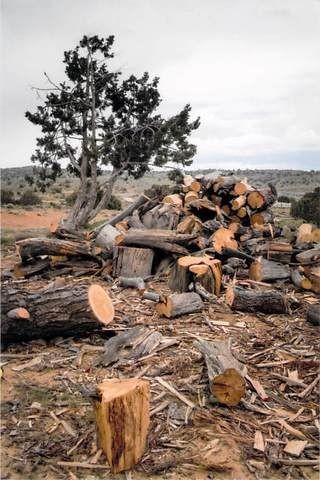
3 orders of firewood (in this case that payment will actually go towards electricity bills at her daughter’s home where she is now living. When we spent time with her at the Rug Show she mentioned that she gets very cold and had to turn the heat up high and that adds a considerable cost to her daughter’s heating bill.


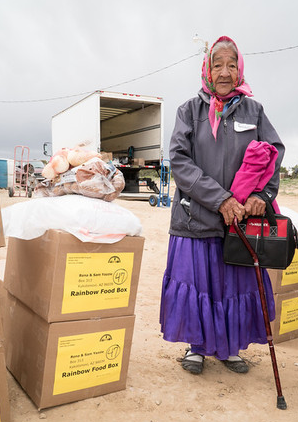
Food Box to be delivered at the Spring Food Run -Elders at the Dilkon, Leupp, Birdsprings, and Pinon food runs have indicated a preference to receive a Bashas food certificate rather than a set of food boxes of comparable value. These Elders live in areas where shopping at Bashas is relatively convenient, and with the certificate they can make their own choices of food items. If you’re not sure which food run area your Elder attends, we will make sure that the appropriate choice of boxes or certificate gets to them.
A $250 gift card from Walmart
The total cost for these items was approximately $1800 and this allows us to send additional yard, food certificates and a Rainbow Box in the Spring.
Our grandmothers will be grateful to receive these gifts and especially during the Holiday Season.
Thank you again.
Robyn, Britney and Ashlee


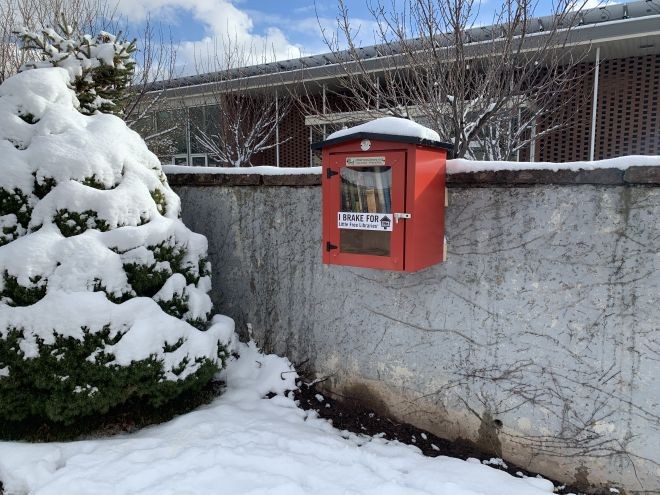
MCS- Now Steward to a Little Free Library

All around the world little free libraries are popping up. These libraries are helping to bring communities together by providing a peaceful meeting place where everyone is welcome to share in the joy of reading, imagination, education, sharing, and creativity.

Maria Montessori defined joy by saying, “Joy, feeling one’s own value, being appreciated and loved by others, feeling useful and capable of production are all factors of enormous value for the human soul.” She taught that the development of language is part of the development of the personality and that words are the natural means of expressing thoughts and establishing understanding between people. Montessori philosophy teaches that careful preparation of the space and materials is key to a successful classroom and learning environment.


It is our hope that by having a Little Free Library we will help bridge the gap between the development of language and personality, creating that space where all members of the community can share and further expand and stretch to ensure a solid foundation of being able to express peaceful thoughts and understanding toward others.

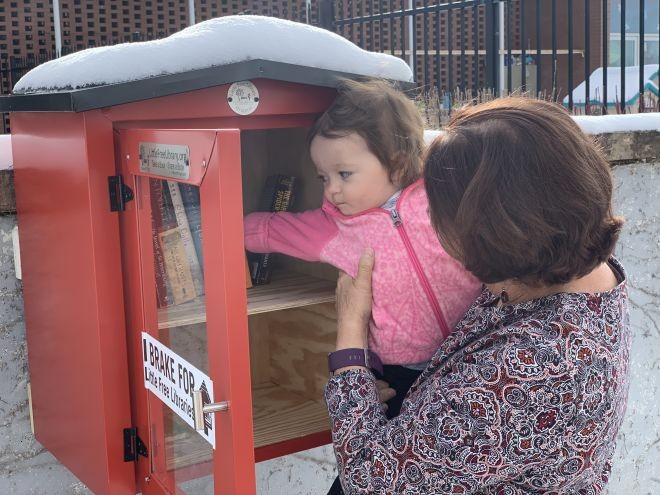
MCS is ever grateful to Jaymison Petersen, a member of our PSA and an Upper Elementary parent, for gifting us such a beautiful little library to be shared by all. The Little Free Library can be found in the front of the school on 1700 South, attached to the cemented wall.

Tips for a New Montessori Parent

A happy welcome to the new families entering Montessori Community School.  Parents, you will soon discover that being a part of a Montessori community is encompassing and the efforts you make towards supporting the Montessori approach will determine the success your child has in this environment. Below is an article by Edward Fidellow which will give you several tips to embracing your new role as a “Montessori Parent.”

And so begins your journey……

Becoming a Montessori Parent by Edward Fidellow

There are seven simple steps to becoming a Montessori parent. When we say simple we don’t mean that they are not challenging. It is a lot like the definition of bull riding. “The object is to keep the bull between you and the ground.” Simple – but challenging.

The first step to becoming a Montessori parent took place when you enrolled your child in a Montessori program. That in itself is a challenge. Most of us weren’t raised in a Montessori school. The whole concept is foreign and takes a bit of courage to step out of the norm and our comfort zone. We may have chosen the program because it wasn’t like our school experience (which is why we chose it.) Or we chose it because we saw something unique in a Montessori child we knew. Or we were just plain lucky and stumbled on to a Montessori school and were fascinated by what we saw. Even then we had to deal with the question, “If this is so great, how come the whole world isn’t lined up outside the door to enroll?” (Which is the same question Montessorians keep wondering about too!) But you made a complex and challenging decision to become a Montessori parent. And here you are. So how do you get the best out of your decision? You go to step two.

You begin to understand the core philosophy of what Montessori is all about. Fortunately, you don’t have to become a Montessori teacher to be a good Montessori parent. (You don’t have to know how to manipulate all of those materials and you don’t have to keep fifteen children from climbing the walls.) The most significant Montessori concept is to respect the child. I can almost hear the wheels turning “Of course I respect my child, I love them very much that’s why I have them in Montessori, I want the best for them.” Of course you love them – but respect is different. Respecting the child is first, to respect the nature of children. Children are not mini adults waiting to be molded. They are like tadpoles and caterpillars that have their own form and function of life waiting to become what they are intended to be. We are often impatient for them to become because we don’t realize that childhood – with its curiosity, playfulness, messiness and all – is part of the process of them transforming themselves into the adults they will become. We have to respect that process – which doesn’t mean they always get to do what they want. One of the operative words in Dr. Montessori’s writing is the word “train”. We do need to train our children but we need to train ourselves “not to destroy that which is good” in the nature of our children. The second part of respect is to respect the personality of your child. Your child is not a blank slate. They are already imbued with the unique characteristics of who they are. The artistic bent is already there. The math bent is already formed.The leader, the follower, the giver, the taker, the extrovert, the introvert are already dna’d into your child. Right or left handed, right or left brained are already formed.

So how do you cooperate with nature? You become an observer. That is the next step in becoming a Montessori parent – you train yourself to observe. What does your child gravitate to? What gives them great joy? What occupies them endlessly? These are all clues to who your child is becoming. You are fortunate that you have a trained helper in your child’s Montessori teacher. Your next parent conference should ask more than what has she done but who do you see her becoming. It is hard to cooperate with nature if you are not aware of the nature of your child.

Our third step is to become their champion. I know. I hear you say, “Of course, I’m their champion. I love them.” And so you do. But are their goals your goals? Translation: Do you have goals for them that do not take into account who they are. (There are many jock fathers who do not have jock sons.) Yes, you have many wonderful goals for them to be caring and loving, honest and faithful, upright, truthful, etc – and these are worthy, significant and meaningful goals which they should attain to. But the expression of their lives – career, vocation, work – is best met and fulfilled according to their gifts. When your five year old says, “I want to be a fireman.” He may be reflecting the latest book or television program he’s seen. However, if you continue to ask the why questions, “Why do you think that would be a good job? Why do you think that you would enjoy that?” you may discover that your child is not drawn just to the excitement but to the fact of wanting to help people or he likes the aspect of being part of a team. All are important clues to his personality. Your child needs you to champion and encourage his personality (especially, if it is different than yours.)

The fourth step is to practice what they learn at school – grace and courtesy. Please and thank you, may I, excuse me, please forgive me and a host of other considerations practiced (and modeled) at home will go a long way to giving your child every advantage in life. People respond favorably to a child with great manners.

Fifth, practice independence. Independence is the ability to be self-governing and that comes from making choices, living with the consequences and having responsibilities. As often as possible give your children choices. “What do you want for breakfast, cereal or eggs?” “Do you want two spoonfuls of carrots or one?” (Don’t offer choices where there are no choices. “Do you want carrots? They say no and you serve them anyway.) Give your children chores they can accomplish – making their beds, putting dirty clothes in the laundry, dishes in the dishwasher, etc. Chores build responsibility; responsibility builds independence; independence builds confidence.

Sixth, give them the gift of time. Give them time to accomplish their chores. Give them time to be children. Give them time to breathe. Give them your time.

Seventh, practice humility. They have a lot to learn from you. What is easy for you as an adult is mystifying and beyond challenge for them. Let your words be seasoned with grace. Look for the good in what they do. Their motives are often pure; their actions imperfect. Yet, we have a lot to learn from them also. And when you are wrong (when, not if) practice the humility of saying, “Please forgive me.” It will not destroy your authority or their respect for you. It will teach them one of the great lessons of life – when you fail, whether it’s in a relationship, school, career or life – own the failure and start over again – to succeed another day.

Becoming a Montessori parent is to become the best parent you can be.

“There is No Bad Weather, Only Bad Clothing.”

Last night’s forecast promised rain (and snow!) for the weekend.  Today, I have noticed the forecast has shifted from snow to rain and back to snow in just a few short hours.  Ahhhh, Utah! While I love the weather and all it has to offer and am particularly pleased by how Utah weather can change on a dime, I feel fiercely protective of our children and their preparation for the weather.  Nature is a beautiful gift that is best enjoyed when it is respected.

Parents, please help your students develop a healthy respect for nature by encouraging them to be prepared for whatever Mother Nature has to offer on any given day, especially here at school!  Children should come prepared to go outside in any circumstances.  Layers, good shoes, water resistant outer clothing, and extra options are a great start.

Montessori Community School has always made it a priority to integrate nature into our program. Students are offered a wide variety of opportunities to extend their learning beyond the physical classroom and, in keeping with the Montessori philosophy, students are invited to experience nature as a hands on experience.  We love the phrase “there is no such thing as bad weather, only inappropriate clothing.”  The Portland Montessori Collaborative posted the following on their website and we are proud to say, “We couldn’t agree more!”

We believe in integrating the outdoor classroom into every child’s experience at school. The outdoor environment is a place for big body play, where we value natural opportunities for children to challenge themselves physically. Children will find compelling reasons to hone large motor skills through joyful interaction with a landscape similar to that found in nature. In the outdoor classroom, open ended and collaborative play are valued, documented, and encouraged. Opportunities to practice practical life skills like woodworking and caring for plants and animals are available. A relationship with the plants and animals that live in our creek side ecosystem is developed through a process of ongoing, child-led/adult fostered investigation. There is dedicated time outside every day, rain or shine.  We believe that ‘ there is no bad weather, only bad clothing’, and children come to school well equipped to enjoy their time outside regardless of weather.

Read more from The Portland Montessori Collaborative at pdxmc.org.

Home – The Montessori Frontier

There are many parts to a Montessori education. There certainly is the beautiful materials that add so much to the enjoyment of learning. There is the educational philosophy that goes along with the materials. There is also the part that looks at your child’s gifts and abilities but the most crucial part of  a Montessori education is the part that nurtures and helps transform your child into a successful adult. Ultimately, Montessori is a philosophy of life, of a way to approach the challenges and blessings.

If you love what Montessori does for your child at school begin to implement at home those actions that will continue the transformation. We are not talking about red rods, alphabets or math but about the core value that makes Montessori dynamic and transformational. It is all about making wise choices.

It is a simple formula – learn to make wise choices – but it is a complex process made up of multiple simple actions that combined together create this outstanding outcome for your child. Montessori succeeds because it gives children the opportunity to make choices (and deal with the consequences). If you have made a bad choice, to be able to make another choice until you come to a positive outcome.

You begin the implementation of Montessori at home by creating opportunities for choice. When my son was two we began choice making with something as simple as breakfast. We would offer him the choice of two cereals. I would ask, “Do you want this or that?” And he would make a choice. (However, since I didn’t use the proper names of the cereals, cereal became known as “dis and dat”.)

Choice making has to be real. Don’t offer a choice and then negate their choice. “Do you want carrots?” “No.” “Well, here you are anyway.” Real choice would ask, “Do you want one spoonful or two?” Other examples of empowering choice might be “Do you want to wear blue pants or black”; “Do you want to brush your teeth first or a take a bath first?” There are endless choices to make each day.

Along with choice goes responsibility. When you make a choice you own the choice because with choice goes the responsibility of fulfilling it. However, a great lesson to learn is that not all responsibilities are our choice but once given to us it is a wise choice to fulfill them.

Chores at home become part of this process of wise choice making. How do I choose to fulfill my responsibilities? Doing my work well, finishing on time and finishing thoroughly are key ingredients of lifetime success. In life we are often faced with situations that offer no real choice – paying taxes, stopping at red lights etc. Teaching your child to make wise choices (even when there is no choice) is to teach them to choose their attitude when faced with less than desirable choices. They can learn this if you let them practice at home.

Article written by Edward Fidellow

www.crossmountainpress.com


Structuring Screen Use in the Home

Welcome to November; it’s cold and dark early in the day. While there is really no such thing as bad weather, only the wrong clothes, and we’d all benefit from spending a bit more time outside, the unfortunate reality is that many of us hibernate inside for much of the fall and winter. Along with this, we may also find ourselves filling more of our time with screens. While technology enhances our lives by connecting us with family, friends and information from around the world, it is also a worthy idea to set boundaries on its use. But technology is so deeply ingrained with most of our daily lives, do we really know just how much time we spend on screens. How do we know what is too much? How do we evaluate the content of what our children are viewing aside from general rating systems? Do we have to preview everything our kids watch and play?


Fortunately there are numerous resources available to help parents understand how to be media savvy and to help their children develop the same skills. A helpful place to start is understanding how much screen time children should have in their daily schedule. The American Academy of Pediatrics has developmental recommendations for media use by school-age children and adolescents and media use in children under age 5. Along with these general guidelines, you can make use of an online family media use planner, which can help structure screen time within the other requirements of the day including making sure there is adequate time for the appropriate amount of sleep based upon your child’s age and screen free activities. For those with school-aged children and adolescents who may be unsupervised more often, a media use contract can be a handy tool to set guidelines around what content is viewed, how much time is spent with screen based media, and to establish other general guidelines for good digital citizenship. When it comes to content, the IMDB Parents Guide and Common Sense Media are great resources to evaluate the themes presented in various media forms (books included on Common Sense Media).

Article written by MCS parent, Dr. Melissa DeVries, P.h.D.


Adopt An Elder’s 29th Annual NAVAJO RUG SHOW & SALE

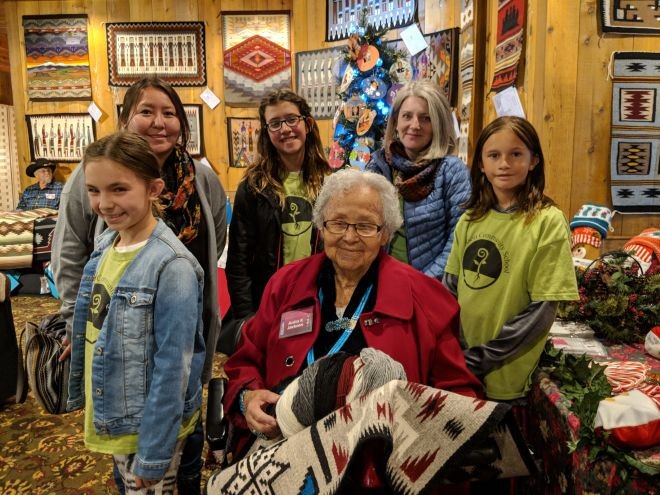
Grandmother Anita Jackson

Approximately 25  years ago, because of Bob and Robyn’s strong connection to some Navajo friends, our school registered with the Adopt A Native Elder program to adopt three Navajo grandmothers and two grandfathers. Our two grandfathers died a few years into our involvement with the program and then for most of 20 years we continued to help support our three grandmothers – Grandmother Emma Bahe, Grandmother Roseline Jackson and Grandmother Elvira Horseherder. For many years we have been so successful with our fundraising that we were not only able to  provide food on each of the two Food Runs that originate in Park City but also send yarn, gift certificates for them to buy additional food, clothing and household items, firewood, basic medical supplies and blankets but in the past few years two of our Grandmothers – Emma (aged 94) and Roseline (aged 92) have died and we recently adopted a new Grandmother – Anita Jackson and do hope to help others as there is dire need for assistance.

Bob and Robyn had the opportunity to be involved in a Food Run to the Navajo Reservation in New Mexico a few years ago and at that time had the opportunity to drive to the Navajo Reservation with the Adopt a Native Elder group and to spend time with our own grandmothers and many others. It was an incredible, heart warming  experience and we hope to participate again in the near future. The elders are such beautiful people who are warm, funny, talented artists, sometimes shy and above all extremely grateful for all of the assistance that they receive.

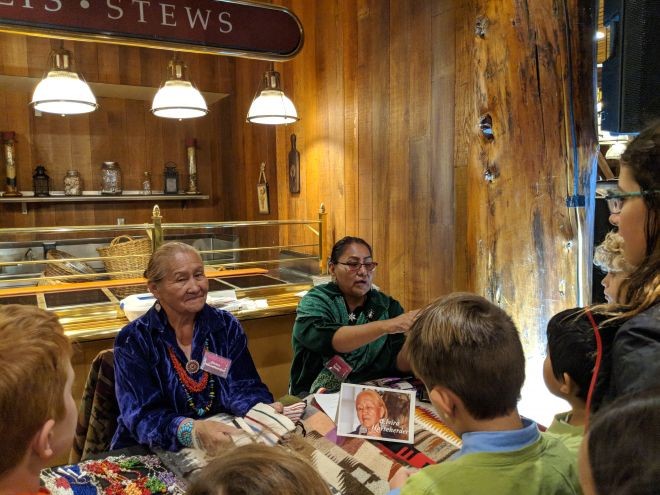
As part of our involvement in the program many of our students have had the opportunity to attend the school presentation and this year our 3rd and 5th year Elementary students will be doing so on November 8th. The children are able to witness various elders weaving, making maize flour etc., to see the huge display of stunning Navajo rugs and jewelry and to listen to some of the elders talking about their lives and culture while living on the Navajo Reservation.

There are several wonderful public events you can attend over the weekend that many of the elders are here in Utah and you can find information on all of them at anelder.org. We would really encourage you and your children to attend one of these events if you are able. Adopt-a-Native Elder Newsletter.