Author: Alejandro Malespin

Holiday Giving Projects

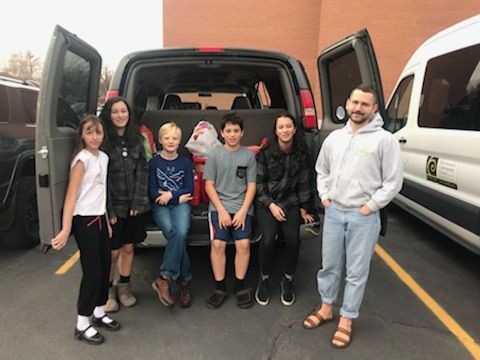
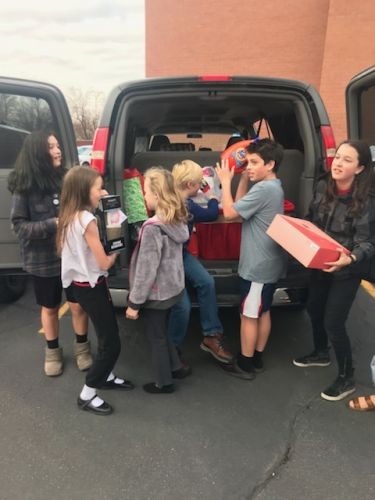
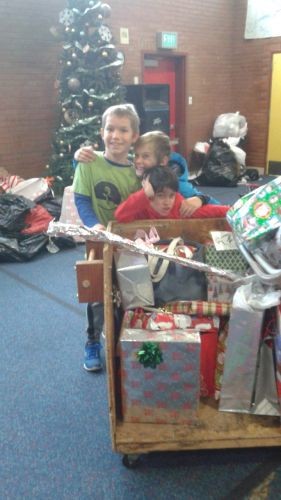
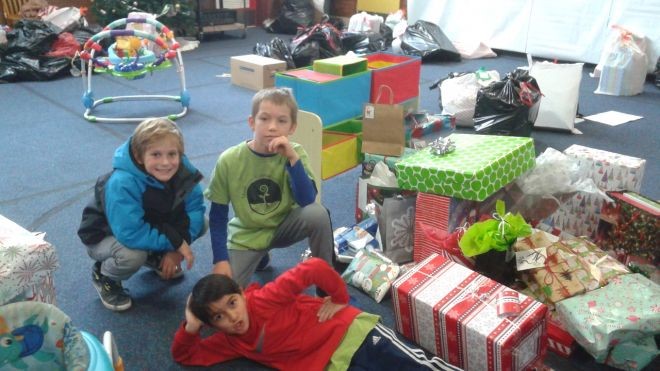
Every year the Montessori Community School supports local charities, which offers students an opportunity of Service Learning and helps those in need. With combined generosity from our families and staff we have gathered gifts for families and individuals at the Neighborhood House and The INN Between.

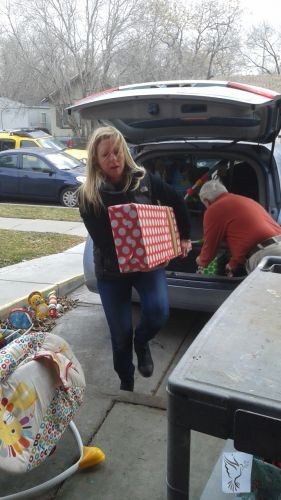
This morning, our 6th year students helped load and organize all the gifts into the vehicles and our 3rd year students were able to help deliver the gifts along with our PSA and some members of Admin.

Students and staff delivered the gifts with the help from our PSA members. Please enjoy photos of the gift distribution. The kindness of our community will bring a happier holiday for those who may have otherwise gone without.

Thank you to everyone who donated and helped support these local organizations and helped your students to learn more about service and helping others in need. We hope you have a warm and safe holiday!

Building the Adult Community

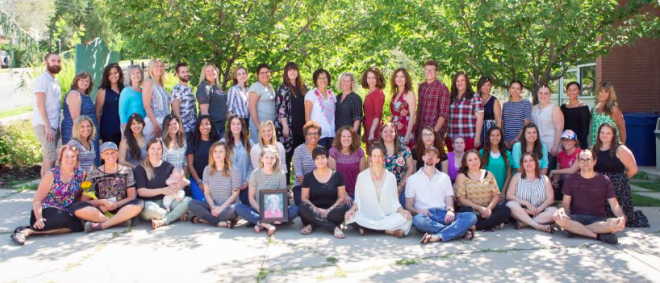
Oftentimes when parents visit our school for a tour, they ask about our staff. How long have the staff been here? How often is there turnover of employees?  Are the people who work here happy?  While these are difficult questions to answer without the input of the teachers themselves, we often find ourselves describing the vision for community and how that applies to our staff.  The human factor is strong in a community such as this where we have over 200 children, at least twice that many active parents, grandparents and guardians, and a total of 62 employees.  With so many people under our roof, we have discovered that building community is essential to providing successful outcomes.

We strive to build community in a number of ways; including in and among classrooms, with parents, and as a staff.  Below is an article written by one of our Lower Elementary teachers, Brandi Allen, who is currently working on her M.Ed. at Westminster College, wherein she describes how our staff community functions.  It is because of the vision of the school owner and director that we strive to cultivate a community of awareness, kindness, support, and joy.
Exploration of Adult Development

In reading about the different theories of adult development, I was pleasantly surprised when I read the chapter on Indigenous Ways of Knowing. This theory felt familiar to me, as I have worked in a culture enriched with some of its components for over 20 years. It makes sense that this would be a theory used at my current workplace, Montessori Community School (MCS), as the owner/director/head of school is the descendant of a Māori chief from New Zealand.

Our head of school leads in a way that is inclusive and she sees a global picture. Our school name has community in it because her focus is on creating a productive group of individuals with an emphasis on the individual’s growth within the group dynamics. As stated on the website for MCS, “The mission of the Montessori Community School is to provide a rich, individualized educational experience, which guides and nurtures the natural unfolding of the whole individual and inspires a lifetime love of learning and peace” (2017). This fosters development through not only the children that we teach and work with, but also the faculty and staff.

There are many ways that staff members are encouraged to cultivate a cohesive faculty that cares for and works toward being integral parts of our school family. We have many dialogues between staff members to try and problem solve; we eat together, play together and care for one another creating relationships both in and out of the school. As Cajete (2015) states, “If our ways of knowing focus on relationships, as Indigenous cultures do, then we will choose to educate our people in ways that build relationships-in community. Relationships become the means, method, and context for learning” (p.197).

Each of our classrooms has at least two co-teachers that are in a relationship that reminds me a lot of marriage. We help cover each other as needed, we meet about the needs of our students, classroom and programs and make decisions together to make for a collaborative unit. It is important for us to see our connection to one other and realize that our actions impact the whole of our school. Many hours each week are spent with pairs, teams, and programs meeting to communicate about being more effective and compassionate Montessori community members. “Through the conversation, people form and reaffirm their values, their relationships, their ethics, their consciousness, and their communal experiences. They come to see things in a similar light, since the form of communication is specifically and culturally based” (Cajete, 2015, pp. 199-200). As with any family, members do not always agree. And there can be some strife between individuals that can take a lot of time and effort, to work on improving. Many of our teachers and staff have worked at the school over 20 years, which allows us to know one another better and work on our relationships while addressing difficult situations.

In addition to our director having a Māori lineage, the philosophy of Dr. Maria Montessori follows many parts of the Indigenous Ways of Knowing theory. Dr. Montessori refined her peace curriculum while she was exiled from her home in Italy escaping the rule of Mussolini and Hitler in the middle of the 1900s. She lived in India for many years with her son Mario contemplating how best to bring about social reform and peace through education (Trudeau, 2003, p. 4). Much of our teaching in the Montessori classroom comes from the idea of stories being told to show the connection of people, animals, the environment, the creation of the universe and humanities ability to better the world with their presence. This exposure to a nature based mythology rich curriculum ties into working with the theory. “An immense variety of myths, metaphors, and symbolic complexes present the nature-centered orientation of Indigenous epistemologies in the Americas.” (Cajete, 2015, p. 206)

Our school has staff members from Iran, Mexico, New Zealand, the United Kingdom, Ireland, Panama, Myanmar, Canada, as well as from all over the United States. This brings diversity to our community and draws on inclusiveness and understanding of other cultures. We are encouraged to be a part of this global citizenry that has a “holistic social context that upholds the importance of each individual as a contributing member of the community” (Cajete, 2015, p. 203). When I first met the director and her assistant director at the time (who is from Japan) I remember thinking this was a great opportunity to experience and work with a variety of individuals in one small school that seemed unique in Utah. It was so inspiring to meet people from around the world with their varied perspectives and cultures that they eagerly shared. I was able to learn about communicating and working with others from many different developmental experiences. As Taylor and Marienau point out, “social learning as a way to encourage adults to be open to seeing, relating to, and learning from those who are different from themselves” (p. 264, 2016) is important to an adult’s learning process.

In growing and learning in this environment for over 20 years, I feel that we are not only a unique educational facility, but that we are incorporating this dwindling way of knowing which seems so important at this point in time. It is my hope that MCS will continue to thrive and embody this enriching way of teaching, knowing and being.

A successful community is made up of a variety of different talents, strengths, skills and goals. As our students engage in peaceful conflict resolution, modeled by the adults in the community, they learn to function as many parts making up a whole. As they assist in the management of the environment, including caring for the physical space, taking on important leadership roles within the classroom, and engaging in group discussion about how to make change for the better, students practice life long skills of considering others and building functioning communities. (Peterson, 2017)

Brandi Allen, 2017


References


Cajete, G., PhD. (2015). Knowing, learning, and remembering-as communities.

Indigenous community: Rekindling the teachings of the seventh fire (pp.197-220).

St. Paul, MN: Living Justice Press.


Mission statement. (n.d.) Retrieved October 8, 2017, from https://mcsslc.com/about/mission-statement


Peterson, B. (2017). Creating a place for peace. Retrieved from https://mcsslc.com/blog/entry/creating-a-place-for-peace-1


Taylor, K., & Marienau, C. (2016). Facilitating learning with the adult brain in mind: a

conceptual and practical guide. San Francisco, CA: Jossey-Bass, A Wiley Brand.


Trudeau, C.M., S.N.D.de N. (2003). Montessori’s years in India. Junction City, OR: Louise Bogart.
Why Podcasts are Good for Kids

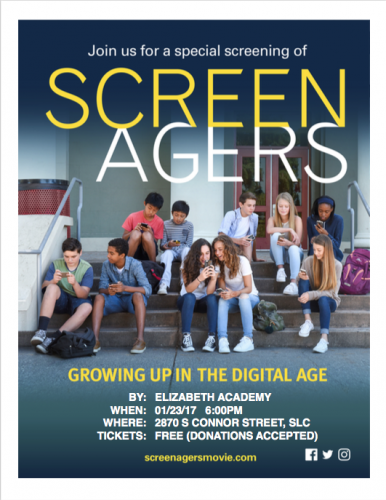
Do you have a long car ride ahead for Thanksgiving or just looking for activities to do with your kids off screens? How about a podcast? I love podcasts and listen to them with my kids often because, as I’ve written about before, we have a rule in our family about not using cellphones in the car. Every time we hear a new one we learn something, and it sparks conversation and debate. Furthermore, as Stephanie Hayes writes in the Atlantic:

“The absence of images in podcasts seems to be a source of their creative potential. Without visuals, listeners are required to fill the gaps—and when these listeners are children, the results can be powerful. Numerous studies have found that children between the ages of seven and 13 respond more creatively to radio stories than to stories shown on television. Audio stories prompt kids to draw more novel pictures, think up more unique questions, and solve problems in a more imaginative way than TV tales.”
Here are my top 3 favorite podcasts to listen to with my family–along with a few titles of recent shows:

Freakonomics
How Can I Do the Most Social Good With $100?
Thinking Is Expensive. Who’s Supposed to Pay for It?

Ted Radio
Sam Kass: Can Free Breakfast Improve Learning?
Wendy Troxel: Does High School Start Too Early?

Planet Money
Episode 804: Your Cell Phone’s A Snitch
Episode 369: If Teens Ran the Fed

Some other great ones are This American Life, Radiolab, and StoryCorps. A couple that I’ve heard are good for younger kids are Tumble and Brains On.

For this week’s Tech Talk Tuesday let’s talk about podcasts. Here are some conversation starters:

-Do you ever listen to podcasts at school? If so, are there any you like?
-What do you think of listening to something other than music in the car?
-If you were to do a podcast, what would it be about?

For more discussion ideas, you can peruse past Tech Talk TuesdaysTech Talk Tuesdays.

Delaney Ruston, MD
Screenagers’ Filmmaker
www.screenagersmovie.com
415-450-9585

A Note from the MCS Green Committee

In our last note, the MCS Green Committee discussed the importance of minimizing packaging in the lunches/snacks we send with our students to school. There are many alternative lunch packaging options that help reduce waste and provide a cost effective way to give kiddos an awesome meal. Many of you already use reusable lunch packaging. However, listed below are some websites for possible eco-friendly lunch packaging/meal service products. We are certainly not pushing these items, but offering ideas (they might also be great holiday gifts). Let us know your thoughts on any of these products, or if you have other great ideas. Likewise, a bulk order discount option might be possible if there is enough interest. Any parents interested in the bulk order, please email jaymisonp@mac.com.

Cheers,
MCS Green Committee

https://bentgo.com/

https://www.yumboxlunch.com/

https://www.planetbox.com/

https://www.bamboozlehome.com/tinyfootprint-products

https://avanchy.comhttps://www.shopbamboostudio.com

https://www.bambuhome.com

Holiday Montessori Market- 2 Days Only!

Come one, come all to Upper Elementary’s Annual Holiday Montessori Market!

This month’s market will feature many various handmade items. These items will make excellent gifts and/or stocking stuffers for yourself, a neighbor, a friend, or other family members.

Please come prepared this Thursday, December 7th and Friday, December 8th before and after school hours, no later than 3:45 pm, with cash. Your support of this Market goes directly toward our Upper Elementary students’ annual adventure to take place in the spring.


MCS Duffle Bags

Montessori Community School has brought back out MCS Duffle!

The bags are $30.00


They are available for pick-up at the office now.

It is a black bag with the green MCS logo embroidered. This is a great durable bag that can be used for over-night trips, camping, traveling, the gym, gear, and/or our Winter Sports Program.

Social Development in the Montessori Classroom

Through the years I have often been asked about Montessori students and their development of social skills. Some parents, when considering a Montessori education, become concerned that because of the size of the facility, the mixed age groupings, or the limited number of classrooms that their child will somehow be “missing out” on some aspects of social development. The short answer is that although there might not be as many children on our campus, the opportunities to develop socially are unlimited in the organization of the classrooms and curriculum.

“Social life does not consist of a group of individuals remaining close together, side by side, nor in their advancing en masse under the command of a captain like a regiment on the march, nor like an ordinary class of school children. The social life of man is founded upon work, harmoniously organised and upon social virtues – and these are the attitudes which develop to an exceptional degree amongst our children. Constancy in their work, patience when having to wait, the power of adapting themselves to the innumerable circumstances which present themselves in their daily contact with each other, reciprocal helpfulness and so on, are all exercises which represent a real and practical social life and which we see, for the first time, being organised amongst the children in a school. In fact, whereas schools used to be equipped only so as to accommodate children, seated passively side by side, who were expected to receive from the teacher (we might almost say in a parasitic manner), our schools, on the contrary, have an equipment which is adapted to all those forms of work which are necessary in an active and independent little community. The individual work in which the child is able to isolate himself and to concentrate, serves to perfect his individuality and the nearer man gets to perfection, the better is he able to associate harmoniously with others. A strong social movement cannot exist without prepared individuals, just as the members of an orchestra cannot play together harmoniously unless each individual has been thoroughly trained by repeated exercise when alone.”

Maria Montessori

The Early Childhood Aspens class invites the Willows class to a formal lunch to celebrate their friendship in November. 


As her philosophy developed, many standards were set into place which help a student develop socially. Some of those include:

  • Grace & Courtesy: An essential part of the Montessori curriculum is the opportunity for children to develop skills of grace and courtesy. Children learn to interact appropriately with one another through dialogue with adults, they learn to greet and host guests into their classroom, and they learn to dialogue with their peers in classroom meetings. As early as three years old students use the “peace table” as a place to they learn to recognize personal feelings and express themselves. They often share a “peace object” of some kind (ie; rock, flower…) that can be passed back and forth as they work to solve problems with their peers. As part of the Grace and Courtesy curriculum, children prepare and share snacks within the classroom. They are given lessons on appropriate meal behavior and sometimes teachers will join students at the lunch table to model appropriate meal behavior.
  • Small Group Lessons: Though many lessons are presented to students individually, at all levels students participate in small group lessons. These lessons allow students to express their thoughts and ideas in a safe environment. As they dialogue with one another regarding their thoughts about a particular subject, teachers can assess conversational skills as well as how much or little a child may be grasping an important concept. When a child is uncertain or misunderstands a concept, teachers will represent material in a different way or within a different setting rather than reprimanding or shaming a child for misunderstanding. In these group lessons, students learn to listen to and respect other children’s perspective.
  • Care of Environment: At entry into a Montessori environment children are given lessons on care of the environment around them. They are taught that the space in which they learn is their space, it belongs to them. They are taught the value of community and learn their role in a community. They are also taught to respect and value the roles of their peers within the same community.
  • Freedom to solve problems: Along with lessons on how to solve problems, children are given the freedom to actually practice the skill in a safe environment with caring and observant adults nearby. Montessori believed that children like to work out their own social problems and she said, “When adults interfere in this first stage of preparation for social life, they nearly always make mistakes….Problems abound at every step and it gives the children great pleasure to face them. They feel irritated if we intervene, and find a way if left to themselves.” In order to accommodate this freedom, teachers use lunch, recess, and transition times to continually model appropriate social interactions. The time for lessons does not stop once the bell to step outside the classroom rings.
  • Lack of Competition: Mixed age classrooms, individual progression, and self-correcting materials are all contributors to the ability to avoid competition among children in a Montessori environment. Students have a natural tendency to assist one another and collaborate. Oftentimes only one material of its kind will exist within a classroom, teaching children patience as well as allowing them to plan ahead, and accommodate change. Montessori said, regarding classroom materials, “The chid comes to see that he must respect the work of others, not because someone said he must, but because this is a reality he meets in his daily experience.”
  • Self-Correcting Materials: Work in the environment is set up to allow the child to use the materials to check their work. As students discover mistakes for themselves, the ability to correct becomes innate and they do not lack confidence for fear of being told they are wrong. It also allows the children to have purposeful movement.
  • Celebration of Individuality: As students are allowed the opportunity to choose what to work on and how long to spend on an activity and the ability to not be rushed to understand concepts, they are able to celebrate their individuality. Some children will grasp a concept more easily than another, some students will embrace one subject at a different time than their peers and as they work with those sensitive periods they grow as individuals. Then, within their roles as an important part of the classroom community, they are able to share concepts with others.

In these ways and others, children in a Montessori environment are given the very best opportunities for appropriate social development.

2017 Navajo Rug Show

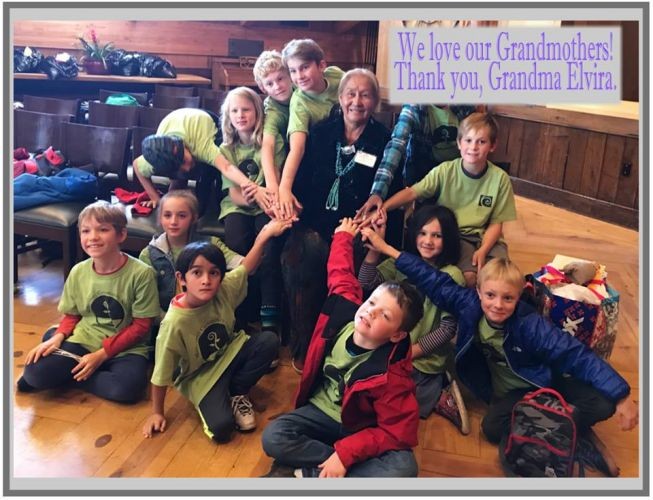
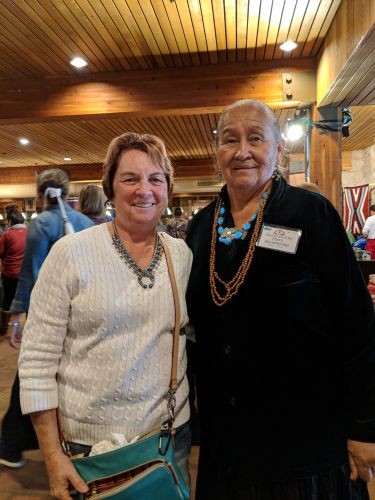
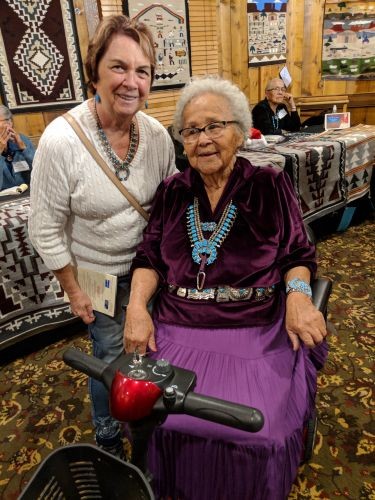
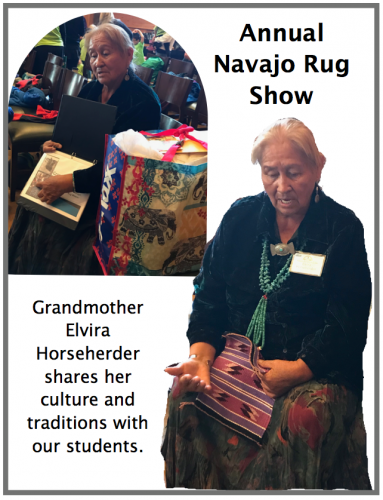
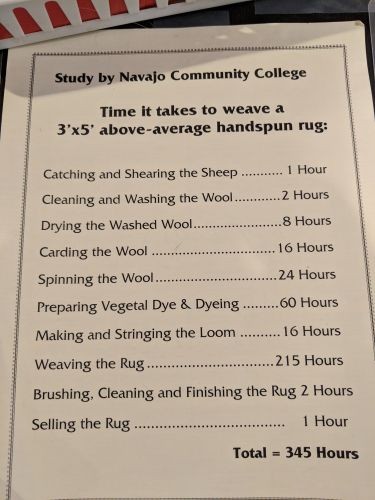
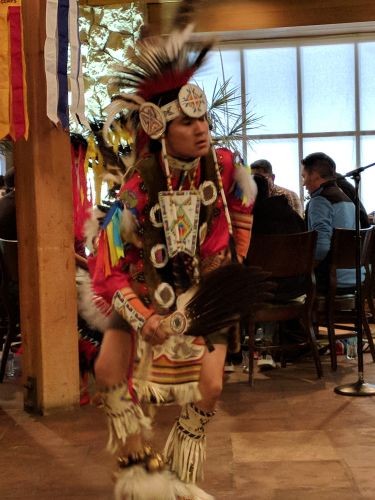
On Thursday, November 9th MCS’ 5th and 3rd year students had the opportunity to attend the Annual Navajo Rug Show at Deer Valley. They were able to meet with one of our two sponsored grandmothers through the Adopt-a-Native-Elder Program, Grandmother Elvira Horseherder. The Rug Show will continue on through the weekend. We encourage families and friends to go and learn more about the Navajo culture.

Our students took gifts to our grandmothers which included fleece blankets, woolen gloves and scarves, soap, hand and body lotion, dish towels etc – funds from the Fun Run. Our grandmothers were so grateful and delighted with the unexpected gifts.

Over the next few months we will be sending firewood (the greatest need at this time) woolen yarn for them to weave beautiful rugs, food certificates and also certificates for Walmart for them to buy clothing and household needs.

Our Head of School and school owners, Robyn and Bob, took the opportunity to attend the Rug Show on Sunday and to spend time with Grandmother Elvira and Anita and get to know more about them and their greatest needs. They are both so grateful for all the support from our School Community.

MCS’ 3rd Annual Scholastic Book Fair

Come one, come all! Montessori Community School’s 3rd Annual Book Fair is in full swing. Thank you to all those who have stopped by and made purchases. The school receives 50% of proceeds that will go toward more books, work rugs, and new school furniture.
The fair will run through this Friday, November 17th, allowing purchases during Parent-Teacher Conferences, in case purchases need to be a surprise for upcoming holiday events.
Please stay tuned for more information on our Online Book Fair- which will include more options for older children and their reading interests.