Foothill Montessori of Salt Lake is excited to announce our first two electric vehicle (EV) charging points. They are available now for staff and parents to use while at the school.
The Montessori curriculum includes a connection with the environment. We appreciate opportunities to explore green energy and different ways that they can help preserve our precious environment with our students. We want to continue to be role models for our students, which is one reason that we installed solar panels on the roof to power the school in 2013 as an alternative fuel.
The school received a grant from Rocky Mountain Power a few months ago with the help of Leaders for Clean Air. The grant afforded the school with two fast chargers. The chargers are located on the South West side of the building. These chargers can be utilized by staff or parents while EV drivers are on campus. We request that you move your vehicle once it is charged so that others can utilize the chargers if needed.
Foothill Montessori of Salt Lake is excited to be able to offer Level 2 Electric Vehicle chargers which are powered in part by the solar panels on the roof of the school. These chargers can recharge most cars within 3-5 hours. The school plans to continue working towards being leaders in environmental conservation and teaching our students about alternative power and renewable energy.
Objective: The purpose of this townhall is to inform and engage stakeholders in regards to the progress being made in revisiting the FMSL Immunization Policy, the refinement of best practices for health and safety purposes, and to solicit input in the Accreditation process.
Meeting Norms: Contribute to meeting’s goals; Listen with an open mind; Challenge the problem, not the person.
In attendance: Approximately 8 Elementary parents, 19 Early Childhood parents, 7 Toddler parents. 20 attendees were staff members, some who are also FMSL parents.
Agenda Item
Description & Minutes
Duration
Welcome
Introductions
0:05
Action Item #1Brandi Allen
Background information was provided: At the beginning of the year parents raised concerns about vaccines and allergies at school.These concerns have been discussed in the context of 3 committees that were created:
Vaccination Policy Review Committee
Infectious Disease Committee
Educating the Community on Best Practices for Health and Safety Measures Committee
0:10
Action Item #2Margaret Mc Donald
Based on Vaccination Policy Review Committee, MCS is reviewing its Immunization Policy. Leadership is consulting with their lawyer as well as parents with expertise in this area. MCS noted that parents have the power to change the policy.
Three options were presented
MCS is aware of the need for herd immunity (having ~95% vaccinated rate per group). MCS currently has 3 students (1.4%) with personal exemptions, and no medical exemptions.
Concerns were raised by parents about the potential risks placed on the community, and parents with professional expertise noted that there is no scientific support for personal exemptions are not supported by science. It was noted that U of U and Catholic schools do not allow non-medical exemptions. It was also noted that pregnant women and infants are immunocompromised, which many may not know.
Parents raised concerns about how option 3 would be implemented – what criteria would be used, etc.
Annual Immunization Assessment Report
MCS is working closely with Utah Dept of Health and will meet the 11/30 deadline for reporting immunization data on all students at the school. Documentation of vaccinations going forward will be incorporated into the FACTS re-enrollment process.
Staff Immunizations
There is not currently a staff immunization policy. MCS is working to gather data from staff to determine vaccination status. A staff vaccination policy is planned.
0:15
Action Item #3Britney Peterson
Health and Safety Advisory Committee:
Infection Control Protocol
Blog posts & Parent Education events
Many illnesses spread very quickly. As MCS staff are not health care professionals, the goal of this committee is to have people to provide extra support for how to respond to situations related to health and safety that may arise.
The committee wouldn’t meet on a regular basis, but these people would be invited to advise the school. Committee members do not need to be health care providers.
When something comes up, those who are able to weigh in can do so, but MCS recognizes parents are busy and may not always be available.
There was a question about the “safety” side of this committee and it was mentioned that there is also an Emergency Preparedness Committee.
Food Allergy Action Plan & Waiver
There is consideration of a waiver for parents of children with allergies, which would be implemented along with annual meetings with parents of children with allergies to review food plans (i.e., how environments are kept safe for the child) and make sure expectations are manageable, reasonable, and able to be accommodated.
A parent asked if there was a way for parents to have more notice about allergies. MCS is looking into how allergy information can be incorporated into the admissions process so that information can be shared as early as possible. However, it was noted that if necessary to keep a child with a new allergy safe, it is always possible there may be a need to be a mid-year change.
Historical context was provided. Robyn brought all to this campus in 2006 to form MCS. Overarching vision was to have as authentic a Montessori school as possible. Many decisions made related back to that goal. Over the past 10-15 yrs the school has been transitioning from a small family business to a larger, broader leadership (as evidenced in organizational chart). More stakeholders have been included, more transparency is being provided.
Strategic Plan Council
Moving forward, MCS wants to put together a Strategic Plan Council that would be a committee option as part of the Parent School Alliance for 2020-2021. This is a way for parents, teachers, other stakeholders to weigh in as objectives and benchmarks are finalized.
0:15
PollMargaret Mc Donald
Poll and minutes published in 10/24 newsletter
Weigh in on 3 vaccination policy options & availability to serve on committees
Parents will be asked what program child(ren) are in, to rank order vaccination policies (if don’t rank MCS will assume policy option is not desired), and to indicate interest in committee participation.
Results of this poll will guide MCS’s decision. It is expected it will be at least another month before a final decision is made.
0:05
Q & ABrandi Allen
Will there be updated info about immunizations in time to meet DoH deadline? Yes
Have parents been providing updated info about immunizations each year? Not consistently
Lots of questions about practicality and implementation of vaccination policy option 3
Would we know if there’s an unvaccinated child in that parent’s child’s class? Yes
Are we getting vaccination info from parents or doctors? Parents hand in health care provider info
Need to consider not only immunocompromised members of community but also the fact that the same folks are all in the same space for a long time; need to think about staff/teachers bringing in disease from outside if not vaccinated
What is the disclosure policy? Particularly for toddlers who are all around each other
Option 3 may be a false choice; will there be complete info before poll goes out
The state is not correct about everything
Concern about whether information needed to make an informed decision on poll is readily available
As a staff we are always trying to maintain a comfortable balance between sun safety and the immense need to get our children outside for play and movement. As you well know, our children are not always easily convinced of the critical need to cover adequately. It is essential that we continue this important practice even during the cold months, when the UV rays are equally impactful. We go to great effort to teach our children the importance of full coverage and how to apply sunscreen thoroughly (while offering assistance to children as needed). We encourage our families to advise their children of the importance of sun safety and appreciate the following tips provided by one of our FMSL parents.
Utah has the highest melanoma (the most deadly skin cancer) rates in the United States (read detailed article here). Given our altitude, a large number of sunny days, great outdoor activities, and a population with lots of fair-skinned people, we have the perfect storm of skin cancer risk factors.
It is important that our kids spend time outside but careful preparation is a must. Below are some measures that have proven effectiveness at reducing UV exposure and helping to prevent skin cancers:
1. Sunscreen reapplication: Unfortunately, sunscreen only lasts ~80 min before the protective effects diminish significantly, so be sure to reapply frequently.
2. Hats: Because the head and neck region is not covered with clothes it receives much more sun exposure than other parts of the body, leading to a higher proportional rate of skin cancers in this region. Hats are an easy method to reduce sun exposure. Be sure to send a hat to school with your child each day as well as taking one along on all your outings that include outside play.
3. Encourage sun-safe clothing, sunglasses when appropriate.
4. Go the extra mile by being an example; wear a hat when you are outside, apply sunscreen to yourself in your child’s presence, wear sun-appropriate clothing and sunglasses, and talk to your child about sun safety on a regular basis. Children, like the rest of us, are empowered by knowledge.
Process Over Outcome: Montessori children learn by doing. At school, we prepare the environment and ensure a child has the tools they need to be successful, and then we are hands off. We recognize that kids learn best by doing (and that this can involve making mistakes). Process overrides outcome, which involves adults letting go of control. Lastly, the more trust we place in our child, the more successful their process will be.
There are a variety of reasons we are seeking accreditation as a Montessori school:
Guaranteed quality;
Program assurance;
Accreditation ensures that standards represent a consensus of values, and that standards and procedures are fairly and consistently applied;
Accreditation is one of several means used in identifying programs for the potential investment of public and private funds, and for determining eligibility for federal student assistance;
Professional Credibility;
The Montessori field gains enhanced credibility through the accountability provided by accreditation. Certifying bodies and state agencies are assisted in the process of issuing professional credentials, registration, or licensure.
We decided to undergo the International Montessori Council accreditation program because they work with the variety of trainings our teachers have, from veteran teachers who have been with us for 20+ years to recently certified teachers, rather than requiring all of our staff to have one particular certification. We have been impressed by the quality and availability of their teacher certification programs. IMC leadership is highly responsive to questions regarding any aspect of leading a Montessori school. They are recognized as an accreditation commission by MACTE, the Montessori Accreditation Council for Teacher Education.
Update:
We have completed the ratings of the IMC Accreditation self-study and are currently working on the narrative portion and gathering the evidence for each standard. Thank you to the parents and teachers who met with the committees to assess FMSL on the five standards: Vision and Purpose, Governance and Leadership, Education, Resources, and Cycle of Continuous Improvement.
Our goal is to complete the IMC Accreditation and in the process to reflect on our school practices, policies, and communications in order to better improve how we fulfill our mission, goals and vision and how we serve our stakeholders (students, parents, teachers, staff, community).
Highlights from the Committee meetings and ratings
Things we are doing well:
Peace Curriculum: parents on different committees expressed how they can tell we practice what we preach. Their children come home and practice the tools they learn in the work it out process of the classroom.
We have clearly defined and well-documented policies and procedures to ensure the integrity of the school’s Montessori program and effective school operations. We continually ask for input from stakeholders in a variety of ways (meetings, surveys, emails, town halls, etc.) to better reflect on how to meet the needs of a dynamic community while all the while upholding Montessori principles.
We are committed to having trained teachers in each classroom and providing professional development opportunities for all staff each year, which allow us to stay informed about best practices in Montessori education.
We stay true to the multi-age classrooms according to Maria Montessori’s planes of development, taking a great deal of time each spring to engineer balanced classrooms from the combination of returning and new students. In doing so we also ensure that the ratio of adults to children facilitates the development of children’s independence and autonomy.
We have uninterrupted work cycles in the mornings and afternoons, another major tenet of Montessori philosophy.
Our prepared environments, in common spaces as well as classrooms, are pleasing to the eye, enticing to children, and developmentally appropriate. We have the full complement of Montessori materials in each classroom.
We have a developmentally-customized, unified curriculum, with integrated studies and a spiraling curriculum where materials teach different concepts to different ages. We employ a variety of instructional and assessment strategies that are engaging, experiential, and responsive to individual student needs.
Things we need to work on (areas that are currently undergoing development and therefore need ongoing monitoring to measure the effectiveness of the current systems and any modifications or addition that may need to be implemented):
Documenting our process of reviewing, revising, and communicating our vision and purpose, as it relates to Montessori philosophy, to community stakeholders. Some teachers and parents may not be aware of all the ways our vision and purpose permeates what we do on a variety of levels.
Administrative leadership is working on consistency in supporting the policies and procedures in place, as well as on the autonomy of the School Director and other Directors in decision making.
We continually work on having enough fiscal resources to ensure that all faculty and staff positions will be maintained as needed to support the school’s vision and purpose (tuition increases help with staff raises each year but we would love to pay staff more competitive salaries).
We continually work on ensuring regulatory compliance, ongoing facility needs, and that potential hazards are assessed and addressed on a regular basis, and communicating that to stakeholders.
We have implemented a written budget for each classroom, specialty class, and camp and extended day programs. We continue to work towards being able to share an annual report that incorporates a financial review with all stakeholders.
We are continuing to work on assessing our educational and operational needs in order to budget effectively to provide adequate materials, media and information resources, and technological infrastructure.
We are working toward creating and implementing a Strategic Plan and/or School Improvement Plan based on assessed data and stakeholder input.
Next Steps:
Complete the narrative portions of the self-study by December 15.
Gather required and supplemental evidence by December 15.
Prepare for Onsite Visit in April 2020.
Receive an accreditation status from the School Accreditation Commission: Full, Provisional (required actions that need to be completed and extra time to complete them), Deferred, or Denied.
Review commendations, recommendations, and required actions of our accreditation status with stakeholders.
Continue to use the feedback from this process to improve/enhance our programs. We will be required to submit an annual report to IMC each year after being accredited, detailing any changes in the five areas of the self-study and progress on the areas identified in our continuous improvement.
Phrases like “helicopter parent” and “lawnmower parent” have earned their reputation with great legitimacy. While the world is changing and childhood may provide more opportunity for danger “in this day and age”, the adult’s approach to protecting children from danger may be more harmful than helpful in some cases. Not only does risky play provide greater strength to the child’s body, but it also teaches skills of assessment, resiliency, and strategic thinking. Small steps with mistake making, practicing the proper use of judgement, and assessing risk are essential skills which prepare a child for success as adults. Practice makes perfect!
This article on Montessori in Nature is a great resource for determining which kinds of risk are appropriate for your child.
Thank you to those who participated in our Health and Safety Committee Meetings last Friday. Many good ideas came from those meetings, which will be communicated at our upcoming Town Hall on Tuesday, October 15th. You can expect to learn more about a possible adjustment to our vaccination policy (of which we will be seeking parent input), the implementation of a new extraordinary measures policy in regards to preventable diseases, the implementation of a Parent Advisory Committee upon whom we can call for guidance in best health and safety practices, and updates about our accreditation process. Please watch for an evite with details and to RSVP for this event. Note that there will be child care available for this event and thank you for signing up in advance in the office for child care.
This year in light of a number of severe allergies in our school community, we are asking everyone to be mindful with the food items available for sale at the Market. Please read and discuss the following guidelines with your students. We sincerely appreciate your attention to this matter!
We are asking all customers to refrain from eating food items at the time of purchase. Parents are welcome to enjoy refreshments in the area designated for Coffee Thursday, while students should only eat these items at lunchtime or in their own classroom/s before lunch (at the discretion of their teachers).
All food items will have corresponding signs informing our customers as to their main ingredients. As a rule, any item individually wrapped should be assumed to contain dairy and/or eggs.
We do ask everyone to be vigilant in washing hands directly after eating to help combat cross contamination.
The honeymoon period for the new year may be wearing off and you may be finding that mornings are getting more and more tough. If you find that your children are significantly less enthusiastic about bouncing out of bed and preparing for school, you are not alone. That said, tardiness to school can have a wide range of negative outcomes for students. Below are some ideas for young children to help bypass the drama. Keep in mind that Montessori children are used to independence, to having a say, and to consistency.
Have 5 bins of the same color available for your child to plan their outfits for the week. On Sunday nights, create time for your child to put outfits together for the entire week. This allows your child the option to choose their clothes for the week, while also limiting the overwhelm of an entire closet or dresser full of clothes when morning time is limited. When my kids were young, each of them had their own colored bins and they were stacked in their rooms for the week. They chose the outfit from which ever bin they wanted each day. BONUS: this is a great way to give your child more involvement and interest in helping with the laundry.
Create a visual chart which shows all the tasks a child must complete in the mornings. Pictures of a toothbrush, breakfast, lunch box, backpack, etc. can help a child feel more independent. BONUS: laminate your chart and let your child use a wipe-off marker to cross off items as they are completed.
When you are about 5 minutes from having to walk out the door, play a song and remind your child that when the song ends, it’s time to leave the house. BONUS: next favorite song? In the car!
Montessori children are used to routine and predictability. Make sure everything has a place and that time for each task is figured in to your child’s routine. BONUS: backpacks, lunchboxes, shoes, etc. are placed in this space upon returning from school each day.
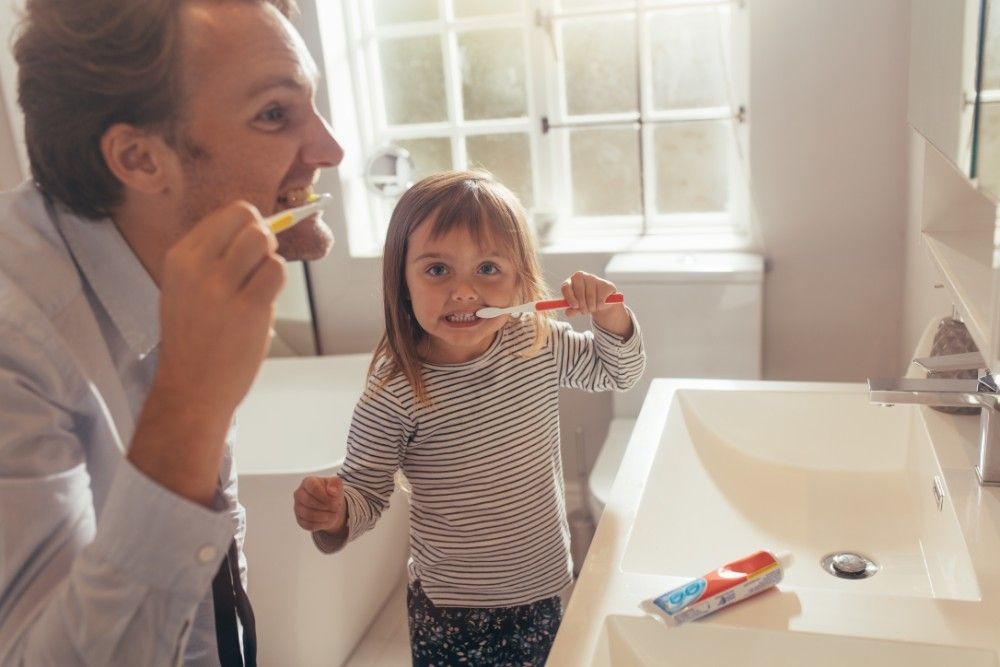
Consider having a visual list of items your child needs to have to walk out the door placed right at the door. Ie; backpack, lunch box, blankets, etc. BONUS: create your own list so everyone’s walking out the door prepared. And, are there any things on the list that you and your child can do together? Think brushing teeth, packing lunches, or putting on shoes.
Prep as many things as possible the night before. Pack lunches, give baths, etc. BONUS: visual charts with appropriate food items help children pack their lunches independently, a great task for kids while you prep or clean up from dinner.
Give your child some uninterrupted one-on-one time before leaving the house. Take some deep breaths together, snuggle, listen to you favorite songs or do some other activity together. BONUS: if this time is set aside for after they’ve accomplished all other tasks, it can be a motivator. However, don’t use it as a consequence for not moving quickly enough. Make this time sacred and consider that some times or some kids might need this sacred time in order to feel motivated to get going. Do what works best for your child.
In the car, talk about what happens when we get to school. Ms. So- and -so will be there to take your temperature and then we will have a hug, kiss and high five, and then I will leave.) BONUS: Keep this routine consistent but, if your child has ideas for adjusting it that are manageable, allow them to weigh in. Most people are more motivated by a plan or routine they’ve helped develop.
Show your child that timeliness is important to you and it will become more important to them. BONUS: peaceful mornings with a moment to breathe before you move onto the next part of your day!