Author: Alejandro Malespin

Revised Immunization Policy Announcement

Dear FMSL Community,

We have spent the past several months gathering information on how adjustments to our policy would impact our school community from both practical and legal perspectives. The details of our new policy are outlined here and the new policy will be written and added to our Parent and Staff Handbooks for implementation with 2020-2021 Enrollment.

Our new policy will require current immunization records to be in each student’s file before they begin school. The policy will require that all students in the Toddler program and those in their first and second year of Early Childhood be fully immunized unless their parents have obtained a medical exemption. The policy will accept medical, personal and religious exemptions for elementary aged students, including kindergarten through sixth grade. We have adopted a commitment to herd immunity wherein the total number of our student body will be considered when accepting exemptions of any nature. Lastly, when a child with a personal, religious or medical exemption is enrolled in a classroom we will disclose such to parents of students in the same class without releasing identifying information about the student or their family.

A major consideration in this new policy takes into account our most vulnerable student population; the safety of our youngest students. Another important facet in determining our new policy was our grant with Utah Online Schools. UOS informed us, initially and on several occasions, that we were obliged to follow Utah’s immunization requirements for elementary aged students. This grant supplies our school with Chrome books and Rosetta Stone elementary student accounts. This is a resource we had planned to continue for as long as it is available to us. UpdateWe have since been informed that we are not required to follow the state’s policy to be eligible for this grant. Further research is being done to learn more about grants we hope to be eligible for in the future. 

Adjustments will be made to our admissions procedure to ensure families making enquiries for enrollment will be notified of this policy before they apply for attendance.  Please note that this policy will apply to all future applicants and those with current personal exemptions will not be affected by this policy.

In addition, we thank those who have volunteered to support one of our parent committees.  We will be contacting people from those committee in January with more information about how we intend to move forward.

We thank all who have been involved and have given time and resources to this process.  We are grateful for your engagement and support.

If you have questions or queries regarding our policy change, we are happy to meet with you in person. Please contact britneypeterson@mcsslc.com or brandiallen@mcsslc.com.

A Note from the Uinta Class – Montessori Market

We appreciate your participation in the Montessori Market which is run by our Uinta (Upper Elementary) class. Their two day Holiday Market was a huge success and thanks to your participation and support, they have earned enough funds to sponsor 14/30 people to participate in this years overnight Adventure.  The Uinta class will plan and execute a river trip this year as a culmination of their Great Outdoors study of water sheds.

Your continued support of the market is appreciated and serves a beautiful cause.  Not only are the students given the opportunity and experience of running various aspects of a business, but they get to support the creative endeavors of those who sell handmade goods in the market. Lastly, their funds allow them to participate in an exciting overnight adventure each year.  With the guidance of their classroom and Great Outdoors teachers, the class organizes an entire three day/two night trip. Each of these are examples of how the Practical Life curriculum is executed at the Upper Elementary level. If you have interest in participating in the market by selling goods, please email the teachers at uintateachers@mcsslc.com.

Wren Monroe, a 4th year student in the Uinta class, prepared a wonderful letter of gratitude for our school community.

Supporting Effective Communication with Children – Parenting Connection

My greatest hope for my children is that they will experience healthy, rewarding relationships.  Sometimes that feels like a tall order when I can’t even manage to carry what feels like a meaningful conversation with my pre-teen and teenage sons.  I’ve learned that asking the right questions is the ticket to successful conversations. “How are you?” and “How was your day?” are sure to illicit one word answers. This article from Positive Parenting Connection shares a list of questions that will help get your kids talking!  Happy Conversing!

Is Foothill Montessori of Salt Lake the right fit for my child and family?

Foothill Montessori of Salt Lake offers an authentic Montessori education while supporting a charming and safe community for our students and their families. Choosing the right school can be a difficult task as increasing numbers in research show the impact of early education on the growing brain. So, beyond why a parent might choose a Montessori education for their child, I would like to answer some common questions about what sets Foothill Montessori os Salt Lake apart and how you will know if it is the right fit for your family.

  • Tour, Admissions Meetings and Observation: Inquiring parents are required to visit our facility prior to acceptance of their child. This allows parents to “get a feel” for our campus and to learn specifics about each program from a knowledgeable member of our staff. Following attendance at a tour or an admissions meeting, parents are invited to observe in one of our classrooms. While an observation is not required, our goal is to help parents have a clear understanding of and comfort in the design of our programs before their child attends classes.
  • Focus on the whole child and their developmental needs: Foothill Montessori of Salt Lake offers an authentic Montessori education where equal attention is given to a child’s academic, social, and emotional needs. Along with learning at their own academic pace, children are given opportunities to learn self regulation and time management, develop and exercise independence and are given many opportunities to practice and refine social graces. Be it math or conflict resolution, lessons are given as needed, allowing children to progress at their own rate and ensuring success of one skill before moving on to the next.
  • Mistakes are the best way to learn: We live in a time where safety concerns have made it difficult to give our children space to make mistakes. Foothill Montessori of Salt Lake is a safe place for children to explore, practice, and learn from their mistakes. Our staff is committed to helping students work through challenges in a safe and controlled environment, preparing them for the world outside of school. Self correcting materials allow children to identify mistakes within their academics and encourage children to try something until they feel confident enough to move on.
  • Multi age classrooms: Angeline Stoll Lillard, in her authoritative research review Montessori: The Science Behind the Genius, describes the Montessori multi-age setting this way: “Montessori encourages learning from peers in part by using three-year age groupings. This ensures that as children move through the classroom they will be exposed to older and younger peers, facilitating both imitative learning and peer tutoring… Dr. Montessori was quite clear about the need for this mix of ages.” These multi age groupings also allow teachers, students and parents to develop close relationships, making a team approach to education manageable and effective.
  • Children get to choose and children get to move: Children like to make choices; they like to be the masters of themselves. In a safe and carefully prepared environment, FMSL students are given the option to choose which area of the classroom to work in at any given time. The carefully prepared environment ensures that there are materials and activities to meet a variety of interest and skill level. They decide how much time or energy should be put into a particular task and children are encouraged to revisit materials or lessons as needed, are invited to move forward when they feel they are ready, and have the opportunity to actively research topics that interest them while giving adequate time and attention to the foundational skills needed in each academic area of the curriculum. Children in every program at FMSL are able to move throughout the classroom, and sometimes beyond, to meet the very important need for movement in their growing bodies. Movement from work to lesson to snack and so forth ensures that children can stay engaged in their work process throughout the entire uninterrupted work cycles. Growing and changing bodies have many options for work spaces and styles.
  • Community: FMSL prides itself on having a close knit and caring community. You will find community in individual classrooms as students stay in one class for an entire cycle and because of the longevity of our teaching staff. FMSL staff have been with us anywhere from 2 to 25 years. FMSL parents are committed to supporting our students, our staff and our programs and a variety of organizations exist to allow parent involvement and support. A number of events encourage the community to come together on a regular basis.
  • Variety in schedules: As part of our commitment to community and family, FMSL offers a variety of scheduling options. Parents can be assured that their children are well cared for, well loved, and respected for their individuality and uniqueness without having to transfer to a different program part way through the parents work day.

Interested parents are invited to learn more about FMSL at an upcoming Admissions Information Meeting on January 17, 2019 from 6:00-7:30pm. Adults only, sorry no child care provided for this event.

Are You a Good Listener – Parenting Connection

Are you a fixer? Critical thinking requires time to analyze and process information. Sometimes the best way for kids to solve problems is to talk and in order to do that successfully, they need someone to listen. Be that person. This funny video is sure to drive home my point; listening can be hard but it can (and will) be worthwhile. This article from The Center for Parenting Education is a great read for parents working to improve their active listening skills.

Holiday Gift Guide – Parenting Connection

Purchasing the right gifts for our children can be difficult.  If you are anything like me, you want to give your kiddos meaningful gifts that engage their minds, inspire creativity, and leave everyone with a sense of satisfaction.  But what kinds of things can make us feel like we’ve made responsible choices as parents but still allow our littles the joyful experience of receiving?

Jamie Davis Smith, a Washington D.C.-based mother of four, posted this excellent list article that offers useful ideas for every age.  Additionally, below we have provided a list of ideas, categorized by age.

Best of luck and happy shopping!

Tips:

  • Do buy toys that are made of natural materials and that require manipulation with the hands.
  • Avoid plastic, batteries and characters.
  • Shop at some of the following – Melissaanddoug.com, FatBrain Toys, MindWare, ThinkGeek, The Red Balloon, The Tutoring Toy and TJ Maxx.

Toddlers:

  • Blocks (wood or soft)
  • Small household items (broom, dishes, cooking items, etc.)
  • Chunky puzzles
  • Push and Pull toys
  • Shape Sorters
  • Plush toys
  • Books
  • Pounding toys/tools
  • Balls

Early Childhood:

  • See age appropriate gifts from above
  • Wood Blocks
  • Dress Up Items (Doctor, Fireman, Police Officer, Train Conductor, Cowboy, etc.)
  • Art Supplies, Easel
  • Small household items (broom, dishes, cooking items, ironing board, etc.)
  • Clay, Play Dough
  • Puzzles
  • Board Games (Candyland, Hi Ho Cherry-O, SpotIt, Memory Games, etc.)
  • Musical Instruments

Lower Elementary:

  • Legos
  • Dolls
  • Books (coloring books, cursive practice, chapter books, etc.)
  • Cars (np batteries)
  • Stuffed Animals
  • Board Games (Sorry!, Candyland, Cranium, Zooreka, etc.)
  • Puzzles
  • Sports Equipment (soccer ball, soccer net, baseball, baseball glove, football, etc.)
  • Art SUpplies
  • Backpack
  • Scooter
  • Skateboard
  • Bicycle

Upper Elementary:

  • See appropriate ideas from above
  • Tangrams, Origami paper
  • Board Games (Apples to Apples, Story Cubes, Trivia Games, Whoonu, etc.)
  • Gift Cards for getting out (Rock climbing, trampoline parks, horseback riding lessons, ice skating, etc.)
  • Music

Parenting Connection – Presence is the Best Gift

We love health, routine, and structure in Montessori.  As parents, sometimes our commitment to these things may be the only things keeping us above water.  In the most busy times I like to remember that most likely children won’t capture in their memories how well kept our homes were or which impressive meals we served, but they will remember what it felt like when we entered the room, our smile, the way we comforted and built them up in the times of struggle. Presence is the best gift we can offer our children.

The Power of your Child’s Birth Story

Have you ever told your child the riveting and powerful story of their entrance into this great life? This is one of my favorite aspects of parenthood. Instilling wonder and thoughtfulness about your child’s emergence to earth is truly awe inspiring for them. Hearing the story of their own birth can calm a child’s fears, can build a child who feels down or sad and can bring great joy to any child. Understanding not only the emergence itself, but the powerful emotions tied to their anticipated arrival and their delivery give a child perspective into their powers as a human. Understanding their place in a family, their most important community of all, is hugely rewarding for a child. Children deeply appreciate learning how their own birth made a marked difference in the history of the universe.

A child will love this story at any point in their life, but the most crucial and powerful time to tell a child the story of their own birth is during the elementary years, particularly early elementary. The elementary child is finding their place in the world. Their understanding of its vastness has become more easy to comprehend and their curiosity about the interconnectedness of all living things is undeniably enthusiastic. Relationships can become deep and meaningful, particularly those outside the family. Children’s search for what matters, their social sensitivities and their developing moral judgement at this stage of development can often lead to questions like “Who am I…how do I fit in?” These are important questions and for this reason their personal birth story can be relevant pieces of the puzzle they are working on personally.

In a Montessori Lower Elementary program, the study of timelines show evolution of plants, animals, and humans. We work to instill a love and respect for our earth. A child’s place in this evolution helps them relate to their family, their social circle, and reinforces that all living things are valuable. Not to mention, humans develop a core belief about themselves at a very early age.  What could possibly make a person believe they matter, that they have the power to change the world, or the power of love more than hearing about the love that enters a parent’s
heart when they meet their child for the first time?

How was your child thought of while in utero?

What kind of preparations did you make for your child to join your family?

What kind of dreams did you have for your child and your family?

What was your child’s anticipated arrival like?

What were the feelings you had when your child’s delivery began?

What are the details about your child’s birth?

How did you spend the first moments/hours/days of your child’s life?

My own three children could recite the stories of their births themselves, and still, they ask to hear it often. We share those memories in times of sadness, in times of fear, in times of joy, in times of laughter. Every detail holds deep meaning for each of us and the parts that speak to us change as we change and evolve as individuals and as a family.
Bedtime stories have never been so much fun.

Happy story telling!

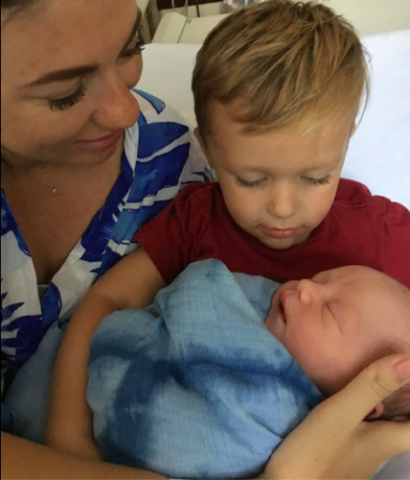
My beautiful family. My sister introduces her son to his new baby brother for the first time.
The magic of families is endless.

Parenting Connection – The Inside Voice

The Inside Voice

One of the things that probably impressed you when you visited your Montessori school was something
you didn’t see, or actually, hear – cacophony. Cacophony is a ten dollar word that might be best
described by what you experience in a New York traffic jam, or when an orchestra tunes up – or in a
typical day care. The lack of cacophony (might as well get all the use we can out of the ten dollar word)
begins with a very simple premise, and most notably found in Montessori schools – the inside voice. It is
an amazingly simple, yet profound exercise. When there is a ceiling above your head – you use your
inside voice.

The advantages of the training that comes with “the inside voice” are many. No one is yelling quiet. You
can hear yourself think – which is one of the great outcomes of a Montessori education – the ability to
think. You operate in a peaceful, calm environment. You can have quiet conversations without having to
raise your voice. It is much easier to concentrate. With concentration comes easier learning and
mastery. And when you go home – you are not wired. (Thank your teachers.)

You might wonder if the use of the inside voice might be oppressive to children who seem to be so full
of exuberance. When you compare it to someone yelling at you to be quiet there is no contest. Re-
reading the instructions – “When there is a ceiling above your head – you use your inside voice.” You
consider its corollary “When there is NO ceiling above your head – you may use your outside voice.”
Montessori playgrounds are full of exuberance.

How do you maintain the inside voice? First, the lesson (it is training) is given many times in the course
of all the lessons that are presented. Second, when a teacher lowers her voice, children usually match
her volume. Or third, a simple pointing to the ceiling, with a smile, is a sufficient reminder.

As wonderful as the outcomes of the inside voice are for the classroom, its real benefit stays with your
child indefinitely. The inside voice is one of the first lessons of self-control. It is a lesson and an action
that is accessible to them. They do not lose their voice (be quiet) but learn to control their voice. This
will be the first of many lessons of self-control that a Montessori education affords them.

There are many other common exercises of a Montessori education that provide dual benefits both to
the classroom and long term to your child. There is the inside walk, which prevents accidents and
disturbing other people’s work. This is a second major experience of self-control that is within their
abilities. A third common exercise is to put everything back exactly where they found it. This experience
is the beginning of the self-control to finish completely what you have started.

These exercises of self-control are major and not as simple as they seem to adults. These exercises call
for great restraint of natural impulses that achieving these are like scaling mini Mount Everests. Children
always seem to have two modes – fast and faster, loud and louder, messy and messier – and the control
of these is the beginning of the foundation of self-control that they will need to achieve success in life
not only for academics but for their place in society and their relationships.

This beginning of self-control is within their grasp hidden in the lesson of “the inside voice.”

Edward Fidellow

Immunization Fact Sheet

  • The terms immunization and vaccine/vaccination are interchangeable. Through immunization/vaccination, healthy children are exposed to small, often inactive pieces of a germ so that their immune systems can learn to fight that germ if/when they are ever exposed to it. 

  • Examples of Vaccine-preventable illnesses include influenza, or the “flu” (over 100 children died from influenza-related causes last flu season in the US), measles (In 2019 thus far, outbreaks of measles were reported in 31 states including Idaho, Colorado, Nevada, Oregon, Washington, and California), rubella (“German measles”)pertussis (“whooping cough”) and several kinds of meningitis. Children who are not immunized for any reason are at greater risk of severe consequences from vaccine-preventable illnesses.

  • Medical exemption for immunizationssome individuals cannot receive immunizations or vaccines because their immune systems do not mount a protective response to immunizations, including very young infants, individuals with cancer, organ transplants or conditions affecting their immune systems. These people depend upon others (“herd immunity”) to be protected from vaccine-preventable illnesses.

  • Nonmedical (i.e., “personal or religious exemptionsThe American Academy of Pediatrics states that nonmedical exemptions to school-required immunizations are inappropriate for individual, public health, and ethical reasons and advocates for their elimination.

  • An immunocompromised person refers to a person who is unable to respond typically to exposures to germs or vaccines. This includes pregnant women and the children they are expecting, infants whose immune systems have not developed the ability to respond to dangerous germs, people with certain chronic illnesses that require them to take drugs that suppress their immune response like people with cancer, organ transplants, or autoimmune diseases (for example, Rheumatoid Arthritis or Multiple Sclerosis).

  • Children at greatest risk for vaccine-preventable illness: Infants are all born with immune systems that are not fully developed. Though infants and toddlers are exposed to many germs, there are dangerous germs that increase the risk of severe illness, lasting consequences of illness (for example, hearing impairment from meningitis, developmental delay from exposure to measles or Rubella, blood infections from chicken pox), and even death.

  • Children in Montessori education are exposed frequently to each other and the risk of germ transmission is higher by virtue of the child-centered, sensory exploration, and close contact with classmates and teachers that is encouraged and valued in a Montessori classroom.

    For more information: https://www.cdc.gov/vaccines/growing/index.html 

    Prepared by FMSL Parents:

    Michelle Vo, MD, FAAP

    Beth Knackstedt, MD, FAAP

    Katie Lappe, MD

    Rita Sharshiner, MD