Creativity in Montessori

So how does this apply to creativity which seems to be in short supply as far as “art work” is concerned? The creative experience in Montessori is an internal experience. The great creativity is focused on the child creating their own personality. They are forging who they are to become by internalizing all of the experiences of both home and family with their experiences of discovery and exploration in the classroom, mixing these with the intangible aspects of their own DNA, their talents and gifts, inclinations and proclivities. They are taking in these seemingly random elements and creating the uniqueness of who they are.
Their great creative work is themselves.
In a traditional classroom environment children are forced into a mold; fairly standardized and compartmentalized. Doing what everyone else is doing, becoming what everyone else is becoming; rushing headlong to achieve external goals that are set without regard to their personality, character, ability or interest. And from this their only escape from this standardization is the occasional art work sent home.
In a Montessori classroom this unique creativity of their personality is an ongoing daily occurrence as they discover the world about them, as they discover the joy within them that rises as they discover the joy of all the creation about them. They are not rushed from subject to subject but get to explore and enjoy the mystery of how numbers work or the mystery of how their language is put together. They discover animals and leaves, science and art. They develop their senses. And it is those senses that create in them the wonder and the enjoyment of the learning that is all about them. They are creating within themselves reservoirs of joy and fascination, interest and passion. (They will learn the names of all the dinosaurs or rock formations or a hundred different avenues of learning because they have created a passion for it out of their daily experiences and discoveries.)
This ongoing creative experience blossoms within them as they are introduced to music and art, color and form. They become experienced (and passionate) observers of all that is around them. Their early experiences with what the Montessori classroom labels the “sensorial” materials heightens and trains their senses. Those pink cubes and the red rods, the circles and squares, the colors and sounds are laying the creative foundation within the child preparing them physically, psychologically, aesthetically and intellectually for a creative response to all of life that is around them.
The real music they learn to sing, the real art they learn to create in their life will arise out of the great work of creating their own personality. Their creativity in Montessori will not only be an escape from the drudgery of traditional learning and conditioning but will be a magnificent expression of the joy they find in learning and the world all around them. While you may not have many pictures to put on your refrigerator you will have a living portrait of a child full of joy and wonder. Now, that is a creative marvel!
Edward Fidellow
www.crossmountainpress.com
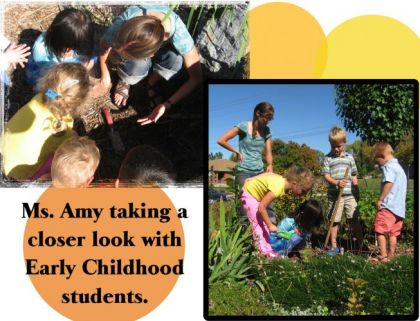
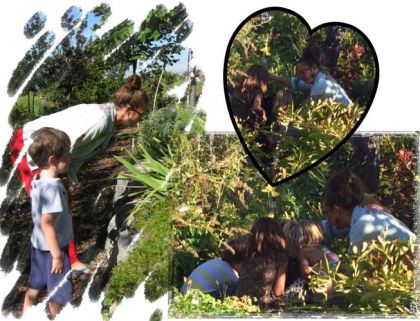
Early Childhood Commences Outdoor Classroom
Lost and Found
Learning the Language of Life
Montessori Children Handle Big Words and Big Ideas
As a parent I was surprised about the words my children knew and used correctly (no, not the bad ones.) We’ve experienced them going from crying to making sounds, from sounds to their first words (mama, dada), from words to phrases (me go) to sentences – “I want candy.” It seems like a long (and sometimes frustrating) process for both children and adults to begin to communicate. We can’t wait for them to start talking and then ironically, we spend a lot of time telling them to be quiet.
The beginning formation of their language skills is “ice bergian.” Ninety percent of what they know supports the ten percent that is audible. The structure of their language has been constructed by and large with little direct input. They have been sorting out the complexity of words and phrases. They don’t yet possess all the building tools to communicate to the world they inhabit. That is why at an early age two phrases dominate their conversation – “Why?” and “What’s that?” They are continually constructing and they need solid linguistic materials to build with.
Baby talk is sweet but does not contribute to linguistic development or communications. At an early age, at least by three if not sooner, children are ready (and capable) of big words and big ideas. A Montessori education builds on this sensitive period for language and learning by introducing advanced concepts. Parents are often amazed that their child can say “equilateral triangle” let alone know what it means. But is equilateral triangle any more complex linguistically than Elizabeth Washington?
A Montessori classroom is constantly introducing new concepts and constructs and a major part of this introduction is linguistic. It does little good to point out squares or circles unless you can call them by name, define them and find them again. Montessori education is noted for its “Three Period Lesson.” First, you present the article. “This is red.” “This is blue.” Second, you ask, “Can you touch the red?” “Can you touch the blue?” (You see if they have understood the vocabulary.) Third, you ask, “What is this?” They answer “red.” “What is this?” They answer “blue.” (You see if they have mastered the vocabulary and the concept.)
Language starts with the concrete – mama, doggie, cat and proceeds to action – “me go, I jump.” And then it begins to add the color of adjectives – tall, short, biggest, smallest (all demonstrated in the classroom) until language blooms into conversation, discussion (and debate.)
When our son started Montessori at 17 months we wanted to be good Montessori parents by offering him choices he could make. Everyday for breakfast we held up two boxes of cereal and asked, “Do you want this or that?” Cereal, thereafter, became known as “dis and dat.” (In hindsight, we should have been correct and named the cereals for him – but it would have ruined a good story!)
It is important that we correctly name the words and actions of their lives. A Montessori classroom is constantly adding vocabulary to a child’s linguistic development. Studies have indicated that extensive vocabularies are a hallmark of successful adults. This process and habit of vocabulary acquisition is a foundational concept of your child’s Montessori experience.
While we do use body language and facial gestures, oral language is the predominant means of communication. Helping your child communicate clearly their needs, desires, frustrations, etc helps them to move on to the more complex use of language and culture – the ability to define (and embrace) intangible concepts like love, hope and faith. Ironically, (and I don’t know how it comes about) the first intangible concept they latch on to is wrapped up in the words, “It’s not fair.” But it is from there that justice, respect, duty, honor, honesty, loyalty begin to form with the child and are defined.
One of Montessori education’s great gifts to your child is the emphasis and focus on observation. Your child is given training and time to become an observer. As has been said, “You can see a lot if you just look.” The materials and exercises of the classroom are designed to aid your child during these earliest formative years to develop the habit of not only observing but of naming and defining the experience.
It is never just the accumulation of knowledge (or vocabulary) but the ability to use that knowledge to think, to communicate and to formulate the actions that are necessary for success. The more you talk with your child the more you develop the communication skills your child needs to succeed in the world.
Edward Fidellow
Speech, Language, and Hearing Testing
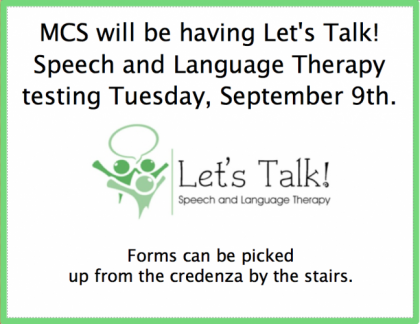
Montessori Community School is offering speech, language and hearing screenings on Tuesday, September 9th. The screenings will be a brief measure of your child’s speech and language skills in order to determine if further speech and language, or hearing evaluations are needed.
The speech and language screening will take approximately 10-20 minutes to complete. After the completion of the screening, we will identify if there are concerns regarding your child’s speech and language skills or hearing. A note will be sent home with your child regarding the results of the screening and if further assessment is warranted.
You might consider having your child’s speech, language and hearing screened if your child shows one or more of the following:
- Your child has a difficult time learning and using new concepts and vocabulary
- Your child has had chronic ear infections
- You and others have a hard time understanding your child’s speech. Your child’s speech is less intelligible than their peers
- Your child does not combine 2-5 words in their speech
- You suspect your child may have a fluency disorder: stuttering
- Your child has difficulty asking and answering “wh” questions
- Your child becomes easily frustrated when trying to tell you something
- See Let’s Talk! Speech and Language Therapy for more information on speech and language delay warning signs
What’s the Big Deal about Table Washing?
Edward Fidellow
Many parents are attracted to Montessori because of its tremendous reputation for giving their children a great academic education. Parents are willing to spend impressive amounts of money to give their children this academic advantage. But as often as parents are impressed with Montessori excellence, they are a little bewildered that their children come home excited about mopping floors, doing dishes and washing tables. (This is what successful people hire others to do.) So there is a real disconnect between what you want, what you are paying for and what you think you are getting.
How then does Montessori get this academic reputation if all you are seeing for six months or a year is table washing and practical life? Montessori success is not built on its finished academic product but on its sure foundation. So what kind of academics comes from table washing? It is the foundation of what constitutes Montessori education which is built on an enduring set of scientific principles. The first is that you always begin with the concrete before moving on to the abstract. There is nothing more concrete in the child’s life than the exercises of practical life. Second, Montessori education begins with the development of all the senses before moving on to the intellectual. Rest assured your child will arrive. Third, Montessori starts with the control of the physical abilities as a precursor to control of intellectual capacity. Fourth, it builds physical discipline – being able to follow through and complete a project before embarking on intellectual discipline. Fifth, it significantly develops focus on details as a skill set to accomplish academic goals. There is a major difference between 2 + 3 and 2 X 3 – and it is only a minor detail. Sixth, table washing (and all of practical life) is not only a physical challenge for beginner learners but becomes an emotional and psychological building block in the development of confidence and self esteem. Real confidence and self esteem is not built on words such as “You did a good job” (whether you did or not) but is built on real achievement and mastery. For a three, four or five year old the process of successfully completing table washing or any other practical life exercise begins a pattern of success. It is a success that comes from beginning a project, working it step by step for as long as it takes until you come to the successful conclusion. This pattern becomes the model for the next stages of academic competence.
What practical life achieves in your child is first a feeling of “I can take care of myself” whether it is table washing or tying shoes. I am given a sense of security that I have some control over my environment and my place in it. Second, it teaches me how to follow steps to success. Third, it builds my confidence by having mastered some challenge which prepares me to tackle even more complex challenges. Fourth, it refines my senses and muscular control so I can effectively use all of the hands on materials in the Montessori classroom to advance my intellectual development. Every sense, every motion, every action is focused to help me achieve academically. The academic success you hear about in Montessori is built on humble and less than impressive activities that are foundational to this amazing achievement that develops the whole child and prepares him or her for significant academic success.
Practical life is a portrait of the future!
Happy Birthday Maria Montessori!
![]()
Maria Montessori – Her Life & Legacy
As we are so deeply indebted to the great work and legacy of Maria Montessori, and in light of her birthday on August 31st, we would like to honor Dr. Montessori by telling her story. Born in a small town of Italy to parents, Renilde Stoppani and Allessandro, Maria forged her own educational path, even in childhood. Throughout her youth, she acquired a very ambitious taste for science and mathematics, which was extraordinary for a girl during the time. After attending a tech school, Maria Montessori decided to study medicine. Throughout an intricate and complicated series of events (including a letter of recommendation for college acceptance by the Catholic Pope himself), Maria went on to Medical School to become the very first female Doctor in Italy.
During Maria’s residency, she spent time working with children in a psychiatric hospital. She had not been working there long, when a nurse who was watching the children in the ward said to her: ‘Look, I can’t believe that they are picking crumbs up off the floor to eat! How horrible.’ Maria said to the nurse: ‘They aren’t eating the crumbs, they are studying them.’ In a bare, sterile psychiatric hospital, where the walls were white and there was not a single toy or object for a child to engage with, Maria Montessori discovered her first realized observation: the necessity of environment.
Dr. Montessori was stirred by this, and a miraculous turn of events then followed. After some time, she redirected her research to completely service children. In time, Maria’s method became world-famous. She traveled to teach it, winning many hearts with her curriculum. In 1913, Maria published her first book on children “The Advanced Montessori Method”, selling 17,410 copies. She even attended the 1915 World Fair in San Francisco to share her research and teaching method. Maria continued to share her knowledge for many years in her own country, until her teachings were banned from Italy due to world conflicts with Fascism. She was forced to leave her home, but she continued her work in Amsterdam, and later in India, where Maria would stay for over 10 years. Even after World War II broke out, Maria stayed to complete her work of the early childhood years in her study of the “Absorbent Mind, “ and her extensive study of infancy and the development of the “Cosmic Curriculum.”
By 1946, over 1,000 people had been educated by Dr. Montessori. Maria continued to travel through Europe, Africa and Asia, lecturing until the age of 81. Maria Montessori has been nominated for two Nobel Peace Prizes for her contribution to education, but also for her overall effort to improve conditions for women and children around the world.
toddler preschool elementary middle school Montessori Philosophy Maria Montessori Montessori in the News
We owe so much to this extremely brave woman, who endured conflicts of career progression, family separation, gender bias and war to bring her teaching methods to light. Maria Montessori was a leader in every step she took, and her work produced amazing outcomes. Maria sought to educate children, but she also saw a magic in them. Within each child, she saw: the need, the power, the magic… to learn.
Speech and Language Screening will be September 9th
ATTENTION MCS PARENTS:
Speech and Language Screening will be September 9th. The screenings will be a brief measure of your child’s speech and language skills in order to determine if further speech and language, or hearing evaluations are needed.
The speech and language screening will take approximately 10-20 minutes to complete. After the completion of the screening, we will identify if there are concerns regarding your child’s speech and language skills or hearing. A note will be sent home with your child regarding the results of the screening and if further assessment is warranted.
You might consider having your child’s speech, language and hearing screened if your child shows one or more of the following:
· Your child has a difficult time learning and using new concepts and vocabulary
· Your child has had chronic ear infections
· You and others have a hard time understanding your child’s speech. Your child’s speech is less intelligible than their peers
· Your child does not combine 2-5 words in their speech
· You suspect your child may have a fluency disorder: stuttering
· Your child has difficulty asking and answering “wh” questions
· Your child becomes easily frustrated when trying to tell you something
·See www.letstalkspeech.com for more information on speech and language delay warning signs
Speech and Language Screening is $20.00
Speech, Language, and Hearing Screening is $35.00
Checks can be made out to Let’s Talk! Speech and Language Therapy
* Please find registration forms in the lobby area.
MCS Studio Classes
Studio Classes have started this week. Please finalize this first session of classes as soon as possible.
Karate- Tuesdays and/ or Thursdays, 3:45 – 4:45
Broadway Kids- Mondays, 3:00 – 4:00 (Elementary), 3:30 – 4:30 (Early Childhood)
Ballet- Every other Friday, 3:30 – 4:15
Functional Fitness for Kids- Tuesdays, 3:45 – 4:45
Cooking with Kids- Fridays, 3:35 – 4:20 (Class full), 4:30 – 5:15 (Space available)
Zumba Kids Jr.- Wednesdays, 3:30 – 4:15
*Note: If your child is not in aftercare, but wants to participate in a studio class, they may go to aftercare until the class begins. You may pick your child up directly from the studio class. If your child stays in aftercare, your studio class teacher will collect your child and return your child to and from class. These classes are a great way for your child to develop interests, have outlets and experiences learning and growing with other friends in a different setting.