Author: Joshi Haskell

Illness Policy – When to Send a Sick Child to School

The beginning of a new school year can bring many wonderful new things; new friends, new classroom works and new routines are just a few of our favorites.  Unfortunately, new illnesses tend to make an exuberant appearance as well.  While we understand that illness at home can impact schedules and routines (for both parents and children) we want to urge each of you to read up on and abide by our illness policy here at MCS.

We will do our part here at school to try to minimize the spread of illness by encouraging lots of hand washing and nose blowing (and then more hand washing) and by sending children and staff home when they are ill.  We ask that you each support us by following the illness policy set forth in our parent handbooks and as listed below so that we might minimize the spread of illness to our students and our staff.  It is so important that our staff remain healthy so that they can be here to help the children settle in and create effective classroom communities.

Should children become ill at school we will do our best to make them comfortable but please keep in mind that we are not staffed to care for ill children in our classrooms or in the office.  We thank you, in advance, for allowing your child to stay home and rest when they are ill.

Warmly,
MCS Staff

Illness

Colds, flu and other contagious diseases are a serious issue in a school environment because they can spread so rapidly. Parents are asked to keep children home when they show symptoms of illness. If the child is ill, please call the school before 9:00am to report the absence. If your child exhibits any active symptoms of illness, he/she will not be admitted to the school, both for the child’s own comfort and to minimize the spread of illness to other children in the school. In the event of an outbreak of an infectious disease, such as measles, MCS will follow the guidelines set forth for schools by the Utah Department of Health.

The following tips are to help you decide if your child should be kept home from school:

  • How does your child feel? Variations from normal behavior are the best indicators of illness. You know your child best; trust your instincts.
  • Fever. If your child has a fever at night, he/she must not attend school the next morning. Temperatures are lower in the morning and a fever may occur again in the afternoon. You are required to wait 24 hours after the fever breaks before sending your child back to school.
  • Upset stomach. If your child vomits during the night, do not send him/her to school the next day. You are required to wait 24 hours after a child vomits before sending your child back to school.
  • Diarrhea. Loose and frequent stools have many causes. Do not send a child to school until bowel movements are normal.
  • Cold. Be sure a child knows how to handle tissues for coughing, sneezing and nose blowing, and practice good hand washing techniques. Your child may go to school as long as he or she does not have a fever or discomfort. If symptoms are severe (e.g., persistent cough or severe runny nose with thick mucous that will consistently interrupt their work or rest time), please keep your child at home so he/she may rest and recover.
  • Earache. Never ignore an earache. Contact your physician and keep your child at home.
  • Strep Throat. A strep infection requires a doctor’s visit and medication. Strep can lead to a more serious illness if not properly treated. The child must be on medication at least 24 hours before returning to school.
  • Contagious Condition. Head lice (see below), scabies, impetigo, chicken pox, strep throat, measles, rubella, mumps, whooping cough, meningitis and some forms of conjunctivitis (pink eye) are contagious and must be properly treated and no longer contagious before your child may attend school. Please notify the school if your child has a contagious condition so that other parents can be alerted.
  • Head lice. Due to the arrangement of student work spaces in the Montessori classroom and the number of collaborative work spaces and projects, if we find signs of lice (nits/eggs), in order to contain the spread we may ask parents to pick up their student early to begin treatment. If parents detect lice at home, please let the Office know immediately so that we can check the rest of the students in the class. Prior to the student’s return to school, we will need to know the specific treatment that s/he will be undergoing and the date that the treatment began, so that we can follow up regarding the second application of the treatment (which typically needs to be applied 7-10 days after the first application). Upon returning to school, before the child enters the classroom, please bring her/him to the Office where he/she will be discreetly checked for nits, and where we can record treatment dates and methods. Students will be allowed to return to class when they are nit-free. Nit removal can take several comb throughs and we ask that parents check the child each day during their treatment. Thorough combing with an egg removal comb each day during the 10-day period following the first treatment is an essential part of eliminating the lice and helping to prevent a lice recurrence. We will follow up, checking students and classes as needed to ensure that all active lice and eggs have been removed.
  • If your child has been out of school due to illness, we ask that you consider whether he or she is well enough to be outdoors before you send him or her back to school. The outdoors is part of our program and we do not have the staff to supervise students indoors and outdoors simultaneously.

Illness or Injury at School
If a child becomes ill at school, he or she will be taken to the office sick area. A parent/guardian will be contacted and will be expected to pick up the child as soon as possible. If a child is injured at school, first aid will be administered if the injury is minor. An accident report will be filed for injuries which require medical attention, including first aid. Parents will be asked to sign the accident report when they pick up their child and will be notified immediately if there are any questions concerning the severity of the injury. The student’s emergency contacts and physicians will be called if the parents are unavailable. All classroom teachers are CPR/First Aid certified. Paramedics will be called when necessary.
The Society by Cohesion: Why Did We Have To Have All These Kids, Anyway?

Below you will find a beautifully written article, written by Montessori advocate and author Catherine McTamaney, about how a Montessori classroom functions.  She so concisely sums up some of the most basic and important tenants of a Montessori classroom (including why there are so many kids in a classroom) to describe their place in our environment and, most importantly, their outcome!

Enjoy!

Glance through some school brochures. You’ll notice quite a bit of language in common: whole child, child-centered, low student-teacher ratios, individualized attention. If so many school settings agree that fewer children per teacher is something to brag about, why are Montessori classrooms so large?


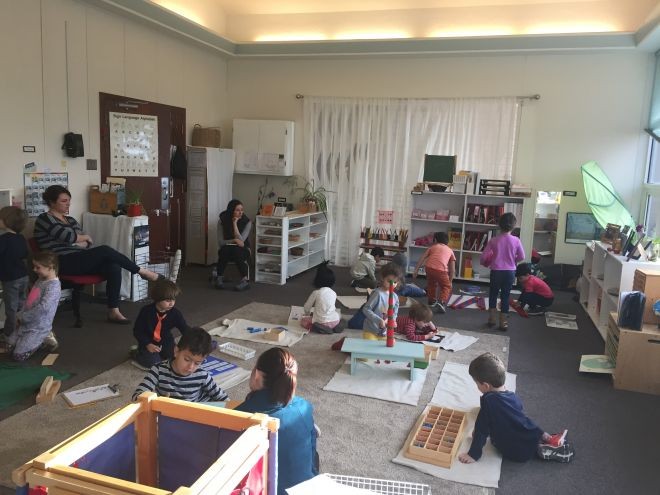
Remember the basic design principles of a Montessori classroom: multiage classrooms, specialized materials and extended time to explore them, professionally-prepared teachers and individualized curricula to match each child.

The curriculum not only complements the first three factors size: it relies on it. Because Montessori classrooms are multi-aged, with specialized materials and professionally-prepared teachers, the curricula can be truly individualized to the child.

The multi-aged classroom allows children to look to and rely on each other to get their needs met independently of an adult. Older children can offer guidance and direction to younger children. Younger children can provide practice and new questions to their older peers. Children across the age spectrum develop independent skills, learning to rely on the tools they have available to them and coming, through practice, to regulate their choices on their own. Children’s natural curiosity and intrinsic motivation to learn are protected when their reliance on adults is limited. There’s simply no space for helicopter adults in a classroom with so many children. Instead, children learn to look to each other or to find their own agency in solving problems, what Montessori called, “The Society by Cohesion.”

The materials, too, help to support the individualized development of each child. Because each lesson is self-correcting, learners need not wait for a teacher to “check their work,” or look to an adult to know whether they’ve mastered a concept. The ability to assess their own learning is fostered by the design of the materials. Meanwhile, their resilience to struggle through challenges also grows, as children work to make sure the box lid closes or to integrate the extra pieces left over while they’re first practicing new lessons. Adults are able to serve the role of facilitator instead of assessor, supporting children’s mastery of the material without devoted hours to checking their work. When materials require an adult’s expertise to “know if they got it right,” the group size necessarily has to be small enough for the adult to assess each child. Self-correcting materials mean that Montessori teachers spend most of their time observing individual children to make sure the materials available are precisely the ones they need and preparing the classrooms that best serve those needs, rather than allotting time every day to respond to children’s work as a human answer-key.

The three-hour work cycle, too, allows for a more individualized curriculum. Learners don’t have to segment their interest into predetermined content areas. They can read whenever they choose, not just during the fifty minutes or so allowed for “Reading” on a traditional classroom’s daily schedule. Extended time means children can spend as much time as they want working on the lessons that motivate them most, delving more deeply into content that’s challenging for them and having sufficient time to figure it out. The extended work cycle also allows teachers to offer lessons to multiple children over the course of a day. A shorter window of time would require fewer children, because the teacher would need to make sure each one had mastered the content she intended for that day before moving on.

None of this could happen without professionally-prepared teachers who know how to observe children, who know their materials well enough to know when to provide them, and who know children’s development well enough to make the connections between what they see and what they prepare. Understanding that the child must know how to learn and not just how to listen, Montessori teachers don’t choose a particular subject area to master; instead, they are generalists among all the areas of the curriculum, and focus their mastery on child development across the social, emotional, intellectual, academic and physical domains. Montessori teachers are not conduits of a prepackaged curriculum. Instead, they serve as scientists in the classroom. Their area of research is the individualized development of each child in the room, prepared for within a context of a larger understanding of children in general and developed to respond to the distinct development of each specific child.

While a Montessori classroom with twenty-four children and two adults in it may have a 12:1 ratio, in practice, they’re 1:1. Children are either working directly with a teacher, one at a time, or they are pursuing their own individual interests and meeting their own individual needs. A teacher’s attention isn’t given in 1/24 servings to each child, but in its entirety to one child at a time. As one teacher is focused without distraction on any one child, the other teacher is available as a resource to the rest of the classroom. The balance results in environments that serve larger groups of children with more individual attention than would be possible in a classroom in which we expected every child to be doing the same thing all day long. The systems of the Montessori classroom support the diversity of learning authentically expressed by individual children who are each unique contributors, no matter how many there are.

August 13, 2018
Catherine McTamaney

A Welcome Letter from School Director, Britney Peterson

Dear MCS Parents,

With open arms and hearts, we welcome you to the 2018 – 2019 Academic year. I always love the energy of the new year and this one is no different. Our hallways are filled with excited students, parents and teachers greeting old friends or meeting new ones. Each material, even down to each individual pencil, has been intentionally placed with care. The floors, walls, materials, etc. are clean and ready to begin a collection of new memories of the year; filled with new adventures, friendships and accomplishments.

For most of us, a new school year signifies creating and refreshing goals. We appreciate the support from our parent community as our administration has undergone some changes. We are hopeful the structure of our revised administrative team will bring about opportunity for growth as a school while we still each strive to protect Robyn and Bob’s (MCS Founders and Owners) vision of an authentic Montessori school founded deeply in community.

Each year we choose a theme for our staff to practice and this year our administration chose the theme “Trust.” We recognize the importance of building trust with our parents, our teams, and most importantly, our students. We invite you to join us in our efforts to develop relationships of trust to ensure the success of each and every one of our students.

I would like to extend gratitude to the following for their time and efforts spent preparing our school for the new year:

  • Our custodial team; Lian, Betty, Felipe Sr. and Felipe Jr., who spent countless hours cleaning and sanitizing our entire school to ensure a safe and healthy learning environment. They also put in extra time and effort to help us rearrange our spaces to best meet the needs of our students and staff.
  • Our IT team; Jemmyn and Brandon, who ensure our systems are set up to support all things technology related.
  • Our office staff; Marisa and Sabine (with immense help from Ashlee) for preparing labels, master lists, schedules, calendars, and a number of other resources that are crucial to the smooth operation of our school. We thank Ashlee who ensures every detail necessary is given the attention it needs.
  • Our business team; Ramira, D’Anne and Kathy, for handling the on-boarding of new students and families with immense love and care.
  • Our Emergency Preparedness team; Ashlee and Margaret, for ensuring our staff were properly trained and for overseeing the proper care and maintenance of our building to ensure the safety of our students at all times.
  • Our entire teaching staff; classroom, specialty and extended day teachers included, for their meticulous preparation of the environment. Also, for those who have recently undergone new training of various kinds to expand upon their teaching skills.
  • Last but not least, Robyn, for sharing her vision and teaching us all to keep the needs and success of the students at the forefront of our minds! She has carefully guided us to this wonderful place and her vision inspires us to improve year after year!

I thank you for giving us the opportunity to educate your children. My door is always open and I feel confident that our administrative team is equipped to meet your needs this year. Please, do not hesitate to stop in to chat!

Warmly,

Britney Peterson
School Director

Letter from Head of School

Dear 2017-2018 MCS Students,

Once again, we have reached a crossroads. Some of you will return to our school next year and continue your experience as a part of our community while some of you will move on to new adventures and experiences. Regardless of where the next year finds you, we are honored to have spent this valuable time with you. We congratulate you for your hard work and for being engaged in our community.

Montessori Community School’s mission is to provide a rich, individualized educational experience, which guides and nurtures the natural unfolding of the whole individual and inspires a lifetime love of learning and peace. Education is a great gift and we feel honored with the opportunity to make peace such an important part of the experience we offer here at MCS. By honoring each individual student and supporting children in becoming their most authentic, passionate, courageous and determined selves, we hope to provide the world with a powerful force for change for the better.

Peace is a work rooted deeply in the approach in Montessori schools across the world and Maria Montessori was nominated for the Nobel Peace Prize on three different occasions as her passion for Peace Education led her to spread its good word in various countries. Her legacy lives on as she is now widely recognized as an advocate for peace and her educational philosophy is practiced throughout the world. We have passionately worked to provide peace education here at MCS for over 30 years.

Our wish for you going forward is that you will find effective ways to bring peace into your work in the world. We hope that you will honor the great gift of education and share the work of peace as you move forward in life.

May the world be better because of you, as our school has been.

With great love,
Robyn

Peace is a goal that can only be attained through common accord, and the means to achieve this unity for peace are twofold; first, an immediate effort to resolve conflicts without recourse to violence – in other words, to prevent war – and second,
a long-term effort to establish a lasting peace among men.”
Maria Montessori

Uinta Adventure 2018 – Fremont Indian State Park

Last week the Uinta class (Upper Elementary, 9-12 year olds) embarked on a great adventure to Fremont Indian State Park. There they enjoyed three days of outdoor fun, experiential learning, and life experiences.

This annual overnight camping adventure was the synthesis of their year’s studies.  As part of their cultural curriculum the students had studied the Fremont Indians while on GO. They explored relationships within and with nature so at Fremont Indian State Park they were able to see and experience first hand much of what they had read and learned about.


Students, teachers and parent chaperones worked together to create a comfortable camp space and prepare delicious meals to be shared. While there they participated in a facilitated ropes course. Team challenges such as “The Wall of Integrity” and “Escape the Sharks” required collaboration and constant communication. Other activities such as crossing the river via the rickety bridge and the wire walk were of a more personal nature, and challenged and stretched all to step out of their comfort zone. Other time on the trip was spent hiking, viewing the petroglyphs and pictographs and playing in nature. At night, we gathered around the campfire and the students entertained with jokes, games and stories.

Thank you to everyone who shopped the Market and supported their other business ventures to make Adventure 2018 possible.

“I had the privilege of chaperoning this year’s Uinta Adventure. It is my daughter’s first year in Upper El, so the experience was new for both of us. I was pleasantly surprised by how smoothly everything ran. The students took on a large portion of the responsibilities for keeping camp life running like a well-oiled machine, while still having time for free play and bonding with friends. We chaperones were there for support and guidance, along with having some of our own camp life responsibilities, but there was plenty of opportunity to step back and observe just how independent our 4th to 6th year students are. I felt it really captured the culmination of growth within the Montessori model and am so pleased I was allowed to participate in this unique experience. Thanks Uinta Class!”

-Melissa DeVries, Parent Chaperone

Spring is a Busy Time


Albert Einstein said, “It is the supreme art of the teacher to awaken joy in creative expression and knowledge.” and, “The only source of knowledge is experience.”

Spring is such a bustling, fantastic time of learning, growth, and development.This is the time of year when you start seeing an explosion of knowledge taking place within your child within and amongst the careful fostering of that knowledge from teachers.

The days are brighter, more before and after school events are taking place, and with the warmer weather, families and children are more active out of doors. Please be aware of how much learning and growth your student is going through while at school.

Help your student to have healthy meals and decent bedtime hours in order for them to succeed at school.

Elementary’s Heritage Fair 2018

Last week, our Elementary students creatively displayed their family’s roots at their Heritage Fair.

The event showcased our students and families histories with unique displays throughout the gymnasium.

After working on these histories for two months with the help of parents, grandparents, elders, teachers, and staff, the students were eager to share and present their gathered information as well as learn about their peers in a new way.

Upper Elementary students also created timelines of many staff members. Upper Elementary students interviewed various staff and cleverly created beautiful displays highlighting these members of MCS.

Prior to the fair, Upper Elementary also hosted a Pizza Parlor where students and families could enjoy a meal together before touring the displays in the gymnasium. This was a a great success and we thank all those families who participated in and supported our Upper Elementary students in this endeavor.


Many photos of this event can be found on Montessori Compass.

Basic Herbology and Flower Essences Studio Class

Studio Class: Basic Herbology and Flower Essences
Donda Hartsfield, Outdoor Classroom & GO teacher
3 Wednesdays, 3:30 – 5:45, April 25th – May 9th

(Elementary Only): Students are introduced to the joy and the science

of herbal awareness and application through sensorial and practical experiences.  Students will encounter such herbs as Hawthorn, Dandelion, Comfrey, Lemon Balm, Sage, Rose, Hyssop, California Poppy, Mint and more.  We will be emphasizing flower essences, as we make three different ones on each class day, which require up to two hours minimal to make! The base for these flower essences will be glycerin as a preservative, rather than the standard Brandy (FYI)!  Students will be preparing and taking herbal remedies home throughout the course.  Fees cover cost of supplies that go home such as bottles, teas, glycerides, etc.  Full attendance is strongly recommended!


Register by Monday, April 23rd! Forms can be found in the MCS lobby.

Wednesday, April 25th

Gathering & Drying Herbs, Glycerides, and Flower Essences – gathering and drying techniques, tasting exploration of herbal varieties including their medicinal properties, preparing the glyceride, making a flower essence

Wednesday, May 2nd

Teas & Flower Essences – Continued tasting exploration of fresh herbal varieties including their medicinal properties as we brew hot infusions, making a flower essence

Wednesday, May 9th

Dreaming Bundles, Finishing Glycerides, & Flower Essences – Practicing the art of informed intention with plants by selecting certain plants for certain desired effects through dreaming bundles which can be placed beneath one’s pillow, finishing and bottling the glycerides, making a flower essence

Spring Camp 2018

This year’s Spring Camp brought students on an exciting adventure through the rainforest! Campers participated in a number of crafts and sensory learning activities that immersed them in the magical world of South America.

On Monday, our students worked to answer the question, “What is the rainforest?” They studied the many layers and characteristics of the rainforest and created their own paper trees.

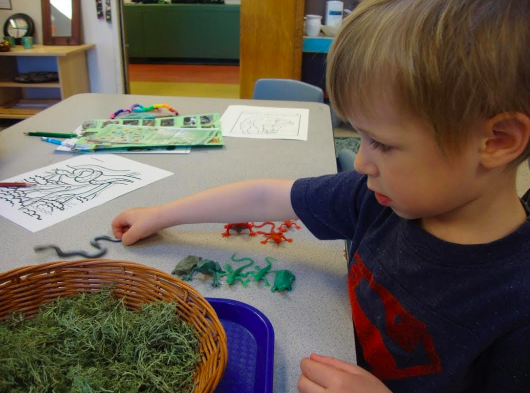
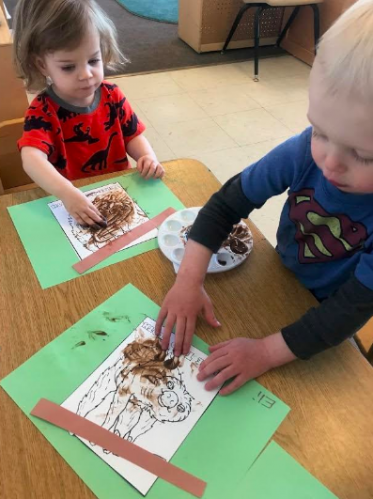
Tuesday, we learned about the animals and insects that call the rainforest home. Early childhood and elementary students were able to create snakes galore with various fun materials, while the Toddlers finger painted their very own sloths and sang “Five Little Monkeys”.

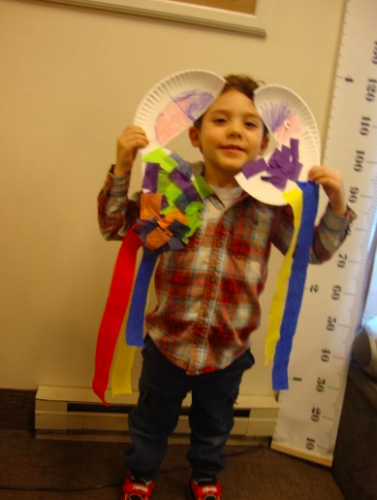
Wednesday brought the exploration of the rainforest’s native plants and birds. Campers created vibrant parrots out of paper plates and colored beautiful pictures of Toucans.


Thursday was very special, as friends learned about food and products from the rainforest – and were able to participate in a tasting of the bounty it provides! Both Early Childhood and Elementary, as well as Toddler campers were able to taste and/or smell items like ginger, chocolate, allspice, mango and coconut! It was so much fun seeing the children make the association between the rainforest ecosystem and the things we use in our daily lives.

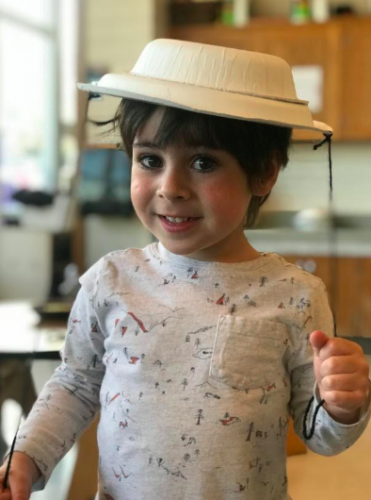
On Friday students participated in a Conservation Safari, complete with paper plate safari hats, duct tape binoculars, and their very own passports! Campers finished the day with a special viewing of Fern Gully, and were able to reflect on the magic of the rainforest and how we can help conserve and protect it everyday.

Thank you to our phenomenal camp director, Candace Leikam, for putting together an amazing experience for our students – and to our wonderful staff who helped provide a week of fun and discovery!

-Crystal Wells

Technology in the Home

We recently had the privilege of hosting a Parent Education Event where a panel of experts prepared and presented information related to the use of screens in the home.  Below you can find some important take aways from that event.  Should you want further information from the event, you can find copies of the handouts on the Scholastic News table in the school lobby.

Current research indicates the use of screens and an investment in social media my be impacting children’s ability to regulate emotion and the things kids are missing out on are worth taking a second look at as we establish the patterns around media in the home.  Dopamine, oxytocin and seratonin levels are impacted by screen use and in turn, other areas of the child and family are being impacted.  The argument that we live in a time that its impossible (or even difficult) to escape the use of technology is worth considering. But does it have to be all or nothing? Like all parenting decisions, we recommend mindfulness in creating structure around your family’s approach to technology in the home.

Bottom line, we all have a lot to learn about the advantages versus the disadvantages of screen time and we are a new generation of parents, paving the way.  The best way to navigate such circumstances is to stick together, share our successes, and keep trying.  Inevitably, we will make mistakes but here’s to creating balance and growing healthy, happy and creative kids!

Below is a quick guide for your reference:


Risks of overuse or early use of screens:

Infant, Toddler and Early Childhood aged children:

  • Language delay (acquisition and use)
  • Behavior concerns
  • Low threshold for frustration
  • Short attention span
  • Lack of interest
  • Aggression
  • Sleep and self-soothing issues
  • Sedentary lifestyle
  • Cognitive delay
  • Memory issues
  • Delayed social development.

Elementary and Adolescent aged children:

  • Increased attentional difficulties
  • Reduced engagement between parent and child
  • Reduced face-to-face interactions, outdoor play (with benefits of problem solving, creativity and exercise), reading, homework completion, participation in chores, and sleep
  • Earlier sexual debut and sexual risk taking behavior (by those who view sexualized media content) due to accelerating the normal rise in sensation seeking seen in adolescence
  • Sleep disturbance (most significantly those with increased daytime and nighttime screen use, especially for those with a television/electronic devices in their bedroom)
  • Sleep deprivation is in turn linked with higher rates of obesity, diabetes, academic underachievement and behavior problems including hyperactivity
  • Increased verbal and physical aggression and propensity for later violence (for those viewing violent content), misinterpretation of others’ behavior as negative or hostile, decreased empathy, less pro-social behavior, increase in violent reactions to confrontation
  • Increased exposure to foodstuff based advertisements (average is 1 public service announcement on health/nutrition for every 26 food commercials; young children have been shown to select items they have seen advertised over those not)
  • Increased rigidity of gender roles and stereotypes (depending on content viewed)
  • Decreased satisfaction with appearance/body image, unrealistic/stereotyped/unhealthy views of beauty and health, focus on thinness and sexualized appearances as being preferred
  • Increased fear, sadness, anger and/or depression in response to viewing news media
  • Difficulty telling real from fake news viewed through media; ⅓ of children admit not questioning the source of their news and ⅓ take no action to verify the truth of news they suspect may be inaccurate
  • Activation of sexist beliefs about sexual harassment, dating violence and sexual assault myths

Positive uses/benefits of the use of screens:

  • Using technology as a way to review and master information taught FIRST by a teacher or parent (i.e. teaching a math concept first, explaining the steps, allowing the child to practice using pen and paper, manipulatives etc. THEN practicing said math concept using a quality math program or application that is designed to aid in the retention of this concept).
  • Television, games, etc. can be a great way to reinforce themes of relationships, managing emotions, problem solving and resolving conflict if they are offered age-appropriately.

Structuring screen time in the home:

  • Co-watch/co-play with your child whenever possible
  • Choose media that supports your family’s values
  • Ask questions about your child’s understanding of what they are seeing. Assess their understanding of reality vs fantasy. Explain advertising and other concepts that may influence your child’s belief systems
  • Set limits on all media access (tv, video games, cell phones, social media, apps, etc)
  • Understand the rating system of video games (and tv/movies). IMDB Parent Guide is great for movies/tv explaining every instance of violence/gore, profanity, substance use, suspense, and sexual content. Appreciate that sexualized content/pornography is embedded into higher rated video games
  • Do not allow children to play video games with unknown users on the internet
  • Create screen free times and screen free zones within your home (bedroom and dinner table are 2 spaces highly recommended to be screen free for ALL family members)
  • Activate a network of trusted adults (extended family, family friends, coaches etc) who can engage your children through social media and support them when they need help
  • Have ongoing communication about digital citizenship and online safety
  • Create a family media plan based on…
      • open communication
      • clearly defined rules and consequences
      • parental modeling of good digital behavior and media access
      • clear expectations, with consideration of exceptions (e.g. do the rules change when family is visiting, when on vacation, when sick, when behind in schoolwork, when friends are over or when at a friend’s house, summer break/holidays, when there is a babysitter). Ensure that all adults responsible for caring for your children are up to speed on the media plan
      • Time limits
      • Age-appropriate application of parental controls/content filters and monitoring of digital access
      • Understanding that supervision and honesty is a component of the plan


Signs that indicate you may need to change your child’s screen use:

  • Social and relational skills seem off to you.
  • Your child exhibits some these symptoms:
    • Irritable
    • Depressed
    • Excessive tantrums, mood swings
    • Low frustration tolerance
    • Defiant
    • Trouble sleeping
    • Disorganized behavior
    • Learning difficulties
    • Poor short-term memory
  • Your child’s symptoms are causing major problems in school, at home or with peers.
  • Your child’s symptoms improve after 3-4 weeks of strict removal of electronics.
  • Symptoms return with the re-introduction of the electronics.
  • Less Reading
  • Less Brain Downtime=fatigue
  • Less Sleep

Book Recommendations:

Jean M. Twenge- IGen- Why Today’s Super Connected Kids Are Growing Up Less Rebellious, More Tolerant, Less Happy and Completely Unprepared for Adulthood